
by Gabriel Donnelly
The Battle of Minneapolis destroyed several myths about Trumpism and provided the city’s masses with a platform for projecting an accurate understanding of Trumpism and how to fight it. First, the ICE raids in Minneapolis during the winter of 2026 highlighted the Left-Accommodationist myth that Trumpism is not as big a threat as neoliberalism. ICE’s barbaric attack on the dignity of immigrant communities, the extrajudicial executions of protesters, and the attempted occupation of a whole city all show the enormous threat that Trumpism is to democracy and humanity at large.
Further, the Battle of Minneapolis has refuted the mainstream liberal myth that appeasement is an effective strategy in the fight against Trumpism. Trump and his cronies put the full power of the American federal government behind the occupation of Minneapolis. ICE, flush with cash and new recruits, invaded the city, and had a lot to prove—the Trumpist stormtroopers were smarting from the humiliation that the Los Angeles proletariat had inflicted on them in 2025. But it was not a strategy of appeasement that forced their withdrawal in Minneapolis. Instead, it was a strategy of direct confrontation.
The self-activity and organization of the Minneapolis proletariat then plainly reveal that direct confrontation with Trumpism is a far more realistic positive program for defending and deepening democracy. A little over a year ago, in June of 2025, I wrote on the LA protests:
the accommodationists misunderstand the significance of the emerging anti-ICE protest movement. The escalating protests in LA and their expansion across the country could represent the beginning of an anti-Trumpist mass movement and a positive program for saving and deepening democracy
Minneapolis accepted the baton from LA. And in the year since that article was written, we have seen such a movement emerge.
What is most remarkable about the Battle of Minneapolis is that the masses were successful. Out of this success has emerged the widespread understanding that Trumpism is not invincible. In other words, the Trumpist myth of invincibility has been busted.
I. The People of Minneapolis do the Impossible Again
Twice this decade, Minneapolis has shocked the world. In 2020, the city’s proletariat burned down the Third Precinct of the Minneapolis Police Department, and with that action showed that the “police are [not] invincible.” Once the vanguard of the largest multi-racial protest movement in American history, the Minneapolis proletariat are now the vanguard of the struggle against Trumpism.
The appearance of strength and invincibility is especially important to fascists, including Trumpists. In the late spring of 2025, the Trumpists were floundering, and Trump’s base had started to notice, for example, that deportation numbers were higher under Obama. To achieve their dreams of mass deportation, Trump and his allies on immigration, like Stephen Miller, sent ICE into LA. There, ICE raided workplaces and attempted to have a visible and unavoidable presence. But the people of LA eventually chased ICE out of the city.
After their defeat in LA, the Trumpists needed to create a spectacle of humiliating immigrants to rebuild their strongman appearance, and they targeted Minneapolis’s large Somali population. It goes without saying that since the Somali immigrants are Black, they are especially desirable targets for a White Nationalist regime. ICE wanted to have video, photographs, and stories of them scooping up large numbers of Black people to broadcast across their propaganda network. This is the inhuman calculus of Trumpism laid bare—a population of people trying to live their lives, go to school, and work were under assault solely to aid the image of a flailing administration. In this way, and others, Trumpism revealed its purely instrumental view of human life and dignity.
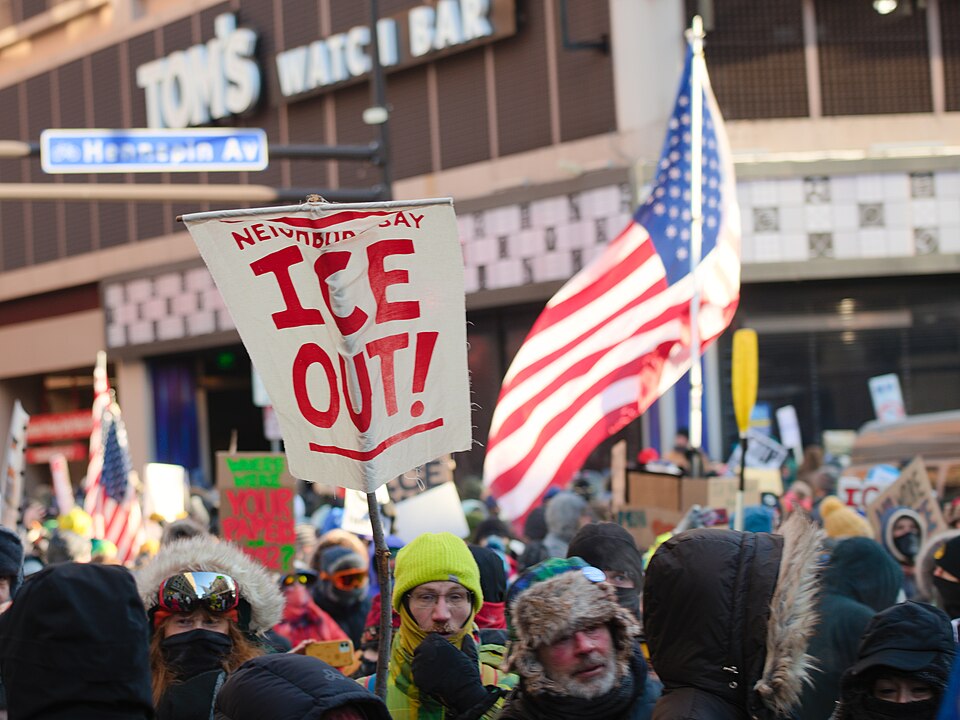 Thousands of protesters marched down Minneapolis’s downtown in subzero temperatures on January 23, 2026. The march was only one part of a multi-pronged resistance against ICE’s occupation of the city. Credit: Wikimedia Commons.
When the occupation of Minneapolis began, eyewitness testimony spoke to the terror felt by the immigrant population. Many people started staying home from school or work. And many people even became afraid to go to the grocery store. In response to ICE’s aggression, and in an effort to protect their neighbors, Minneapolitans immediately began constructing a counter-infrastructure to that of the federal forces. In a matter of weeks, everyday people had organized themselves, their coworkers, and their neighbors into at least three kinds of massive networks: mutual aid, counter-surveillance, and networks for directly interfering in the functioning of immigration patrols and arrests.
Several practical features make these activities so notable—the scale of the organizations, the haste at which they were developed, and the success of the Minneapolis proletariat are all jaw-dropping. But we cannot let the speed at which these counter-infrastructures were built deceive us into thinking that this was easy. People put blood, sweat, and tears into this fight, and two were killed by Trump’s stormtroopers on the streets of Minneapolis. Yet, in the end, the people humiliated Trump and humiliated ICE.
II. Direct Opposition to the Left-Accommodationist Lie
In MHI’s 2018 Perspectives “Resisting Trumpist Reaction (and Left Accommodation),” we identified several tendencies of “leftist” accommodation to Trumpism and wrote that
What all of these currents have in common is that they either downplayed the enormity of the threat that Trumpism poses or did not care enough about that threat. They therefore did not feel the need to act in a principled and effective way in a bourgeois election. Instead, they engaged in play-acting at revolution, casting pointless and self-indulgent votes at the ballot box that benefited the forces of reaction.
Eight years later, there are still some on the Left who continue to downplay the enormity of the threat Trumpism poses to democracy and humanity at large.
In fact, Left-Accommodationism continues to haunt us in various forms. For example, there’s the myth of Trump Derangement Syndrome—which Jacobin Magazine still trots out—that serves to downplay the danger of Trumpism by mocking panicked responses. Then, there is the continued persistence of myths and inaccuracies about what Trumpism is, which are inexcusably out of date. Take, for example, Bryce Gordon’s November 2024 article, “What is Trumpism,” posted on the Revolutionary Communists of America (RCA) website.
Gordon first downplays the threat of Trumpism by stating that while Trump “is inclined toward authoritarian bluster,” his first term as president was “characterized mainly by traditional Republican Party policies” and his “base of support is decidedly not a fascist movement.” He then goes on to suggest that instead of Trump being “on the verge of imposing a military dictatorship,” Americans are “on the verge of a historic upsurge of class struggle in the years ahead.” Not only that, but communists can also use Trump’s base to “build a class-independent communist party”:
By appealing to blue-collar America, Trump draws support from many who identify as working class. This is why the 2024 GOP platform promises to “protect American workers and farmers from unfair trade,” “bring back the American dream and make it affordable again,” and “build the greatest economy in history.” Never mind that this is impossible under capitalism in crisis … A mass communist party could win over many of Trump’s working-class supporters by emphasizing a class program that would raise everyone’s living standards.
Here, Gordon presents the economic anxiety myth from 2016, that is, the idea that economic anxiety is the main driver of support for Trumpism, with a very thin new coat of paint. MHI has written at length on this myth, both in Part V of the abovementioned 2018 perspectives on Trumpism and in a subsequent article analyzing Obama-Trump voters in particular. Especially now, after Charlottesville, the Julius Streicher-level race-baiting against Haitians in the 2024 election cycle, and innumerable other instances, there is no excuse to continue peddling the notion that White Nationalism is not the chief motivator of Trump’s base.
While the RCA has reported on the terrors of the second Trump term, it hasn’t used those reports to inform a fundamentally different understanding of Trumpism. In other words, the RCA does not appear to have walked back on the understanding presented in the 2024 article mentioned above.
The economic anxiety myth lives on because, for groups like the RCA and the Communist Party of the United States (CPUSA), there is a great deal of appeal to the idea that Trump voters are a few Social-Democratic programs away from being activated communist agitators. When this kind of Left-Accommodationism is being peddled, always undergirding it is the idea that “we can win these people over.” But you cannot combat something until you understand it honestly, and this is a dangerous, willful misunderstanding of Trumpism and its base.
The CPUSA is a fruitful example, because the experience of the second Trump term seems to have inspired tardy learning on their part. In an August article on the CPUSA website, Cameron Harrison considered the CPUSA’s role in the 2026 Midterms and shows a much better understanding of the stakes than the organization did in articles published on its website before the election. Harrison argues that previous methodologies of the CPUSA are “untenable in the era of MAGA fascism.” “The task,” according to Harrison, “is to participate wholeheartedly inside the broad, democratic all people’s front to defeat MAGA, while simultaneously working outside it to build the independent political capacity of the working class and the Communist Party.”
This is growth. But it is still deeply mired in electoralism and an effort to build up the Communist Party, which is not necessarily synonymous with, and historically has undermined, the “independent political capacity of the working class.” In other words, it is still an expression of the same “Left-Firstism” that characterizes the strategy of appealing to Trump’s base and which confuses and conflates “what’s good for working people with what’s good for ‘the left,’ i.e., themselves.”
We are deep into the second term, and some Leftists have not even made this halfway step. Whereas Gordon was perpetuating dangerous misinformation about Trumpism, some have gone so far as to champion Trump’s supposed invincibility. These are the most vile and extreme proponents of Left-Accommodationism.
In an article published by the Platypus Affiliated Society in May 2024, Chris Cutrone wrote: “Trump and Trumpism are not going away, whatever we might wish … So, I repeat the question, for the third time, now: why not Trump — again?” Beyond the moral issues with cozying up to a White Nationalist, anti-democratic force, this argumentation assumes the dubious premise that Trumpism is invincible. It thus helps Trumpism with its strongman mythmaking. But this is to be expected—peddling the myth of Trump Derangement Syndrome, and the myth of the fascist strongman, are the stock-in-trade of Cutrone and his ilk.
The events of Trump’s second term have not moderated Cutrone on this point, who in an April 2026 talk said: “Obviously, when the Democrats call Trump a fascist, they’ve been calling every Republican presidential candidate since Thomas Dewey in 1948 and before that a fascist. The Left tends to take up what the Democrats say and treat it in a hysteric, literal way.” Recognizing Trumpism’s White Nationalism and anti-democratic ambitions are then, in Cutrone’s eyes, hysterical.
Compare all these examples with the thoughts and actions of the Minneapolis proletariat. Look at the refusal to learn, the eager downplaying of White Nationalism, and a cowardly, nihilistic embrace of fascism seen on the Left. Then, look at the thoughts and actions of the Minneapolis proletariat, who refused to embrace Trump’s racist attacks on their neighbors and coworkers and who projected an understanding of Trumpism as something that must be fought and can be beaten.
By directly interfering with, or even stopping outright, activities of the federal forces, the people of Minneapolis were making clear their understanding of Trumpism. This force, they said, was not something to negotiate with. It cannot be appeased. It has to be fought and destroyed. Questions of economic anxiety and social democratic remedies are shown to be secondary or outright distractions, because the wagers of this battle revealed the priorities to be simple: assert the humanity of their neighbors and render every effort of the Trumpists fruitless.
III. A Direct Refutation of Liberal Appeasement
The assault of the Minneapolis proletariat on Trump’s strongman image is a direct refutation of the myth that we can effectively counter Trumpism by appeasing Trump. Despite the mounting evidence that directly contradicts the liberal idea that appeasement is effective, figures, forces, and tendencies in the institutions of mainstream liberalism continue to rush to appease Trump. This is especially disturbing given that historians, sociologists, and political pundits have observed how pre-emptive surrender and “obeying in advance” are key parts of fascism assuming power.
By preemptively surrendering to Trump, colleges, law firms, and politicians have directly fueled the fire of the fascist strongman myth. And it is this appearance of strength that Trumpism uses to justify its further encroachments. Thus, liberal appeasement has helped advance Trump’s fascist project. The refusal of the people of Minneapolis to preemptively bow, on the other hand, made Trump, Trumpism, and ICE look weak and ultimately retreat from Minneapolis. It was their direct confrontation with ICE that destroyed the aura of invulnerability that the Trumpists have carefully cultivated.
Trump’s strongman image, which is crucial to the Trumpist project, is more than smoke and mirrors. The struggle against ICE’s occupation required a canny appraisal of the real power and limitations of the federal forces. The people of Minneapolis had to understand what they were facing, beyond the mirage of projected invincibility and tough guy talk of Gestapo wannabes like Greg Bovino. Piercing the veil took constant fact-finding, analysis, and consideration. People worked to keep themselves informed of ICE’s movements and presence, using that data to anticipate and counter expected actions.
All this self-activity, borne out of necessity, demonstrated that the Minneapolis proletariat understood that appeasement is not an effective strategy for countering Trumpism. But that is not all. The self-activity of the Minneapolis proletariat provided the whole world with an alternative argument: Trumpism can be fought and can be defeated. Their success provides evidence for this claim.
IV. Spontaneity, Organization, Theory
The movement in Minneapolis, like the LA riots, provides an alternative to Left-Accommodationism and Democratic appeasement. It has also shown theorists who are concerned with saving and deepening democracy what our current responsibilities are: to elaborate on this alternative. An anti-Trumpist, pro-humanity program has emerged, and whether it flares out or is developed and championed is now partly up to us.
While it is outside the scope of this article to present thorough answers to the questions “Why Minneapolis? Why has this city, twice in one decade, been at the vanguard of the struggle in America?” a couple of factors must be highlighted. First, certain factors in the Midwest’s political economy may be at play. Capital in the region never meaningfully recovered from the 2008 crisis of profitability, and the extractive, alienating reality of capitalism is barer than elsewhere. For example, city councils had to lean on aggressive ticketing measures to try and shore up budgets, which may have contributed to the widespread anti-police sentiment.
Further, to paraphrase Rosa Luxemburg, in the mass activity in Minneapolis, the element of spontaneity plays such a predominant part, not because the Minneapolis proletariat are “uneducated,” but because they refuse to let anyone play schoolmaster with them. Conditions are tough economically, and people are angry. They get squeezed by the cops, they get squeezed by ICE, they get squeezed by Trump, and they are not listening to the elements that tell them that their fury at these indignities is misplaced. The Left-Accommodationists have no audience here, nor do the Democrats rushing to surrender.
On the night the Third Precinct was reduced to ashes, an anonymous protester said
The change needs to be now. Because Donald Trump, Joe Biden … these ain’t the answers. So, something gon’ pop. It’s gonna be a long summer. It’s gonna be a thick winter. We’re getting into some seasons. This is a new norm. Get used to this shit.
Six years later, his analysis bears out. Deeper and lower layers of the proletariat were the vanguard of the Minneapolis Police Department’s defeats. At a time when the reformists rushed to push half-measures, and the police fled behind the blue wall of silence, it was only the collective and concerted activity of the Minneapolis masses that showed the cops were not invincible and forced the prosecution of Derek Chauvin. The masses understood that there would be no accountability for George Floyd’s murder if they didn’t act. This was a sober understanding of the forces at play, and that understanding went hand in hand with their spontaneous actions. Those same layers have resurfaced in the struggle against ICE.
The masses in Minneapolis had no leaders in the trade unions, political parties, or the Left. This indicates that they not only had a clear vision of how to respond to the ICE raids but also outpaced any would-be leaders trying to co-opt their efforts. In the Twin Cities, DSA has built itself into something of a force to be reckoned with—partly by riding the waves of these struggles. The DSA now has a presence on the City Council and has successfully leveraged its bloc into having an impact on crucial votes. Despite all that work, the DSA did not lead the struggle against ICE. They were participants, but it was the workers, organized and unorganized alike, who, paraphrasing Luxemburg again, had “immediately taken in hand” the struggle against ICE. The workers created the infrastructure of resistance and fostered a penetrating understanding of Trumpism’s nature.
In January 2025, many saw anti-Trumpism as a dead letter. While mainstream liberals peddled the line that Trumpism was in ascendancy and could only be negotiated with, Left-Accommodationists continued to be soft on and even pro-Trump. But in the winter of 2026, the Minneapolis proletariat advanced a positive, active program that directly challenged Trumpism and challenged any accommodation to it. Their self-activity is a living theory of how to build democracy back up.
On the streets, the mass movement has made clear its contempt for Trumpism. They are crying out for aid and solidarity in their efforts. Liberal and leftist institutions and infrastructures of power have failed to defeat and even understand Trumpism. The Democrats have tried to appease Trumpism or have surrendered in advance. On the Left, figures like Gordon and his party, and Cutrone and his organization, have downplayed Trumpism’s threat to varying degrees. Those who consider themselves socialist intellectuals, and who have any sympathy for the struggle against Trumpism, must devote themselves to building on the understandings and advancements developed in the street. And they must devote themselves to combating appeasement, apologism, and accommodationism in their own tendencies. The movement deserves no less.
Trumpism has been on the march for a decade. It’s finally time that socialist intellectuals become an asset to the anti-Trumpist movement instead of, to borrow a phrase from Raya Dunayevskaya, a millstone around its neck.

Be the first to comment