
by Theresa Henry
I want to tell you why I think Marxist-Humanist Initiative (MHI) is unique, and I feel the best way to do that is to speak from experience. Thus, in this appeal, I reflect on my time in the Marxist movement before joining MHI and counterpose it to my experience as a member of the organization. My hope is that you resonate with my story and feel encouraged to join MHI or become a supporter.
But first, let me make my point clear: MHI is unlike any other organization I have encountered because it expects and encourages you to develop your capacity to think.
While I suspect that some of you who have become disillusioned with the Marxist movement grasp the significance of this statement, for many of you, this may seem like an odd thing to say—surely, the expectation that people learn how to think for themselves should be commonplace in a movement that proclaims its goal is human freedom! Sadly, in my experience, it is not.
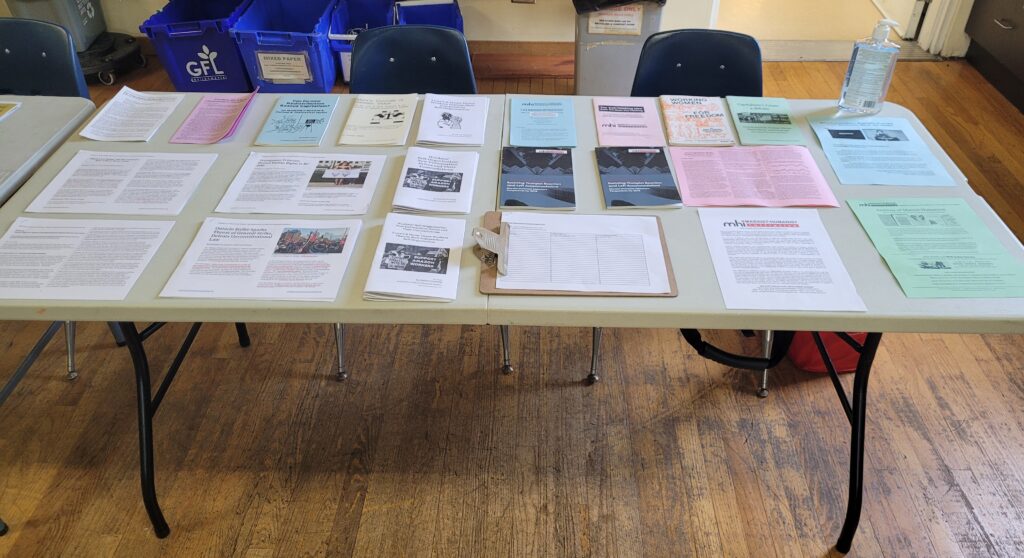
MHI literature table. Vancouver May Day, 2023. Credit: Theresa Henry.
My Experience Before MHI
Before joining MHI, I had been in a variety of organizations, ranging in formality from casual reading and discussion circles to a revolutionary political group engaged in high-stakes, day-to-day organizing and movement work. Often, the more casual groups I was in had no expectations of members. The organizations I was in that had expectations for members, however, often discouraged dissent.
The leaders (me included) of the latter type of organization would talk a great deal about the importance of truth, democracy, autonomy, or integrity. Yet we weren’t very good at practicing our principles. In these groups, I always felt some pressure to adopt ideas because I had “less” experience or knowledge, because they were dominant, because they served the interests of the organization or certain members (as opposed to the movement), or because I was shamed and bullied into doing so—even when I was in a position of power within an organization.
After nearly a decade in the movement, I felt ashamed of myself, confused about my views on philosophy and politics, and disillusioned with Marxism and activism.
Then I found MHI, whose expectations for its members and supporters were clearly outlined in a Statement of Principles and By-Laws visible to people outside the group. I was ecstatic because these expectations aim to discourage the behaviors that alienated me from the Marxist movement: so-called “leaders” using others as a means to gain more social power, further their professional ambitions, or realize some other private interest, and activists pressuring one another to show “unquestioning support” for these so-called “leaders” on all important matters.
I read further and became even more excited. MHI had a clear goal, proportionate to its size and level of influence: creating a “non-hierarchical yet effective and sustainable organization” capable of “projecting, developing, and concretizing Marx’s philosophy of liberation and its further development as Marxist-Humanism articulated by Raya Dunayevskaya.” Not only that, but the organization’s structure itself seemed to serve the organization’s goal and the entire membership’s theoretical and practical self-development.
This is a dramatic departure from the organizations I had been in before that either: (a) had no goals or structure, (b) had unclear goals and an unclear structure, or (c) had unrealistic goals that betrayed the group’s arrogance to everyone outside of it and a structure that encouraged deference to leadership.
Finally, it appeared I had found an organization that was trying to bring the ranks up to the level of leadership, ensure the collective was the decision-maker, and support workers in becoming philosophers. Finally, it appeared I had found the kind of organization I had been looking for when I first joined the movement.
My Experience with MHI
I promise you that I am not exaggerating when I say that nothing has supported my theoretical and practical self-development to the extent MHI has. Nothing has even come close.
Before joining MHI, I started reading Marxism and Freedom, From 1776 to Today by Raya Dunayevskaya. While I was reading it, I had a novel feeling. Since entering the Marxist movement, I had always felt like I was adopting the position or perspective of someone who “knew more than me.” But as I made my way through Marxism and Freedom, I felt like, finally, someone was proving my intuitions—the exact intuitions I was used to being ridiculed for or hadn’t dared to bring up for a long time.
I didn’t feel like I was merely adopting Dunayevskaya’s positions; I felt like we were arriving at the positions together.
My experience in MHI mirrors my experience reading Marxism and Freedom for the first time. I have never felt pressured to adopt an idea, position, or line of thinking because it serves someone else’s interests in the organization or because it is the majority position. The only pressure I have felt in MHI is the pressure to help bring truth into being.[1] But I have not been expected to rise to this responsibility alone.
Over the past three-and-a-half years in MHI, I have been supported in developing the confidence and skills needed to do philosophy. My comrades have, for example, helped me learn how to identify and expose unstated assumptions, unproven propositions, and hidden personal agendas. They have also helped me develop research methods and systems for organizing my research, learn how to spot and explain or correct fallacious logic, and understand standards of textual interpretation.
In addition, they have helped me develop as a writer and editor. I used to struggle to put together short news pieces. Now, I regularly publish theoretical articles, contribute to statements and editorials, handle publicity for our meetings, and provide substantive, stylistic, and mechanical feedback on other people’s writing.
I consider the support I have received from my comrades to be an expression of the fundamental difference between my experience in MHI and any other organization: I feel encouraged to become a person who, as Marx puts it in the Grundrisse, strives “not to remain something [s]he has become, but is in the absolute movement of becoming.” Nothing has been more meaningful to me or harder to come by.
My Appeal
Please consider joining MHI or becoming a supporter.
MHI is small, and within our ranks, there are few young Marxist-Humanists. There are even fewer young Marxist-Humanists who, after the exhaustion of their “civilian life,” have the capacity to contribute consistent time and energy to the organization. In other words, there is no guarantee that MHI will survive its veteran members, and therefore, no guarantee that there will be an organization that takes collective responsibility for the philosophy.
In my view, this would be a tragedy because Marxist-Humanism is distinct from all other Marxist tendencies. Unlike parts of “the left” that align with the bourgeoisie of certain countries under the guise of supporting the so-called “anti-imperialist camp” and “actually existing socialism,” Marxist-Humanists are interested in identifying and supporting new forms of workers’ revolts against both private and state-capitalism.
Further, Marxist-Humanists eschew the fetishes of the Marxist movement, such as “the program” and “the vanguard party,” in favour of doing philosophy because that is where humankind “digs deep down to find the meaning of [its] actions.” We also have no pretensions or desire to try to “lead” mass movements. Instead, we try to help mass movements use Marx’s philosophy of liberation to understand better their historic role in establishing a truly free and human society.
Finally, and perhaps most importantly, Marxist-Humanists want workers to take over our philosophy and organization rather than adapt themselves to our “political line.”
Ultimately, I am appealing to you to join MHI because the survival of Marxist-Humanism depends on an organization taking collective responsibility for its further development. We are trying to build such an organization.
Note
[1] See the conclusion of “Theory and Practice at the Turning Point,” especially page 25 of the PDF document.

What is the process for becoming a member?
Hi Sam,
The process is explained in Section C, here: https://marxisthumanistinitiative.org/philosophyorganization/by-laws-of-marxist-humanist-initiative/amended-december-6-2020-by-laws.
It would be good to meet with some MHI folks first (via Zoom, maybe), especially if you have questions, and to attend meetings, etc. Our next meeting is on April 12. Please write to our email address, mhi@marxisthumanistinitiative.org