

by Anwar Najmadin
Anwar Najmadin is an independent researcher based Kurdistan, Iraq, who has worked primarily as an Information Technology lecturer in Sweden. His published work includes articles in the International Journal of Žižek Studies and Monthly Review.
Communism, Exchange, Transition, and the Abolition of the State: Reconsidering Marx against Political Economy
Introduction
Despite competition among major global powers—from the Soviet–American confrontation to the current United States–China rivalry—the world remains within a single dominant capitalist mode of production. Changes in power relations do not alter the class nature of wage labor, which presupposes capital. Thus, any capitalist “victory” ultimately reinforces the global system of exploitation and class domination.
Contemporary conflicts, including those involving the United States, Israel, and Iran, reflect not only the management of global crises in resources and accumulation, but also pressures on emerging proletarian struggles, as seen in Iran.
These conditions express a shared global reality marked by rising inflation, intensified exploitation, war, displacement, and economic imbalance, prompting renewed debate among socialists and communists about their tasks and historical experience—especially the unresolved question of the state.
The question of the state and the transition from capitalism to communism remains one of the most disputed issues within the communist movement. While most Marxist currents agree that communism entails the abolition of classes and the disappearance of the state, they differ sharply on the historical process through which this transformation occurs. In much of twentieth-century Marxism—Leninist, Trotskyist, Maoist, and social-democratic alike—this transition is theorized as requiring a distinct socialist stage, characterized by the political rule of the proletariat through a transitional state, often presented as a direct continuation of Marx’s own position.
This article re-examines this assumption through Marx’s mature writings on class abolition and the state. It argues that Marx’s analysis increasingly points toward the destruction of the existing state machine and the self-organization of production by the associated producers, raising questions about whether later Marxist formulations of the transitional state truly align with Marx’s historical materialist conception of the transition to communism.
Communism
Communism is a cooperative mode of production grounded in the collective ownership of the means of production. The communist revolution represents the historical process of humanity’s emancipation from political life—specifically from the state, wage labor, value production, and the capitalist relations governing production, distribution, exchange, and consumption. The question of the state is therefore inseparable from the transformation of production itself. Consequently, communist relations cannot be understood through the moral qualities of individuals—such as honesty, laziness, or discipline—but only through historically specific social relations of production.
The central issue in the transition from capitalism to communism concerns the persistence or abolition of value relations. Scarcity remains one of the most contested categories in political economy. Is scarcity a permanent condition of human existence, as Malthusian economics assumes, or is it historically produced within capitalist relations themselves? Capitalist development repeatedly demonstrates a contradiction between the productive forces and the relations of production, most visibly in recurrent crises of overproduction. Capitalism does not collapse because humanity produces too little, but because it produces too much relative to profitable exchange. This raises a fundamental question: is scarcity truly a material limit, or an ideological category reproduced by political economy?
This contradiction reappears in the widespread assumption that money and exchange cannot be abolished until scarcity itself has disappeared. Such arguments merely reproduce the bourgeois conception that money is an eternal necessity of social organization. Vladimir Ilyich Lenin, remaining fully within the framework of political economy, argued in 1919:
It is impossible to abolish money at one stroke.
In order to abolish money, it is necessary to arrange the organization of the distribution of products for hundreds of millions of people, an affair of many years. [Lenin, Draft Programme, pp. 114-115]
Yet Marx arrives at a fundamentally different conclusion. In Capital (vol. 2, p. 358), he writes: “In the case of socialized production, the money-capital is eliminated. Society distributes labor-power and means of production to the different branches of production.”
For Marx, the abolition of money does not result from administrative decree but from the transformation of production itself. Once production ceases to operate through private exchange between competing producers, money loses its historical function. Marx therefore writes in Capital (ibid.): “The producers may, for all it matters, receive paper vouchers entitling them to withdraw from the social supplies of consumer goods a quantity corresponding to their labor-time. These vouchers are not money. They do not circulate.”
These labor certificates are not money in the capitalist sense. They neither circulate as capital nor mediate exchange between independent commodity producers. They function merely as administrative instruments within collective production. Consequently, the abolition of exchange relations depends upon abolishing money as capital in all its historical forms—whether metallic currency, paper money, digital payment systems, bank cards, or cryptocurrencies. The essential issue is not the technical form of money but the social relations embodied within it.
The capitalist mode of production operates through internal economic laws governed by competition and regulated through the law of supply and demand. This mechanism controls the movement of commodities, labor, and money while generating recurrent crises, overproduction, and social instability. In The German Ideology, Marx explains that capitalist competition subjects humanity to an alien force resembling ancient fate itself. Technological developments in one country immediately reshape the lives of workers across the globe. A machine invented in England could deprive workers in India or China of bread overnight. Thus, capitalist production acquires a world-historical character while remaining beyond conscious social control.
Communism abolishes this alien domination by subordinating production to conscious social organization. Production is reorganized according to human need rather than exchange value or profit. Under capitalism, distribution appears as wages, profits, rent, and interest. Under communism, where wage labor itself is abolished, distribution no longer appears through the categories of capital. Distribution becomes a consciously organized social process.
Wherever production remains organized through value relations, social labor continues to confront individuals through the principle of “equal right.” Yet equal right does not signify the transcendence of bourgeois society; rather, it expresses the persistence of bourgeois social relations within both production and distribution.
What, then, is meant by equal right?
According to Marx:
But in order that our owner of money may be able to find labour-power offered for sale as a commodity, various conditions must first be fulfilled. The exchange of commodities of itself implies no other relations of dependence than those which result from its own nature. On this assumption, labour-power can appear upon the market as a commodity, only if, and so far as, its possessor, the individual whose labour-power it is, offers it for sale, or sells it, as a commodity. In order that he may be able to do this, he must have it at his disposal, must be the untrammelled owner of his capacity for labour, i.e., of his person. He and the owner of money meet in the market, and deal with each other as on the basis of equal rights, with this difference alone, that one is buyer, the other seller; both, therefore, equal in the eyes of the law. The continuance of this relation demands that the owner of the labour-power should sell it only for a definite period, for if he were to sell it rump and stump, once for all, he would be selling himself, converting himself from a free man into a slave, from an owner of a commodity into a commodity. He must constantly look upon his labour-power as his own property, his own commodity, and this he can only do by placing it at the disposal of the buyer temporarily, for a definite period of time. By this means alone can he avoid renouncing his rights of ownership over it.
There is here, therefore, an antinomy, right against right, both equally bearing the seal of the law of exchanges. Between equal rights force decides. [Marx, Capital, vol. 1, p. 165, p. 255]
That is why the central issue in the transition to the society Marx calls socialism/communism concerns the persistence or abolition of value relations. Capitalist society is governed by commodity production, money, and exchange. These forms are not eternal features of human existence but historically specific social relations. The transition from capitalist to communist relations of production rests upon new socio-economic foundations, beginning with the disappearance of commodity exchange and its monetary expression. This initiates the historical process of abolishing value relations and, with them, the social principles through which individuals confront one another as owners of commodities. Only through this process does the overcoming of “equal right” become possible, ultimately giving way to a form of distribution based on human need rather than equivalent exchange.
Money is not merely a physical object, such as a coin or paper note, nor simply a technical instrument, whether in the form of traditional currency or cryptocurrency. Rather, it is a social relation that arises from the exchange of commodities among independent private producers. As the universal expression of value, money exists only where production is organized through commodity exchange, whether the commodities exchanged are products or labour-power. Once private production is superseded by collectively organized production, the social relation of value begins to disappear. With the abolition of value relations, money loses its social function and ultimately becomes obsolete.
As Marx argues:
before distribution means distribution of products, it is first a distribution of the means of production, and second … a distribution of the members of society among the various kinds of production. … the distribution of products is manifestly a result of this distribution, which is bound up with the process of production and determines the very organization of the latter. [p. 201 of “Introduction,” in Contribution to the Critique of Political Economy]
Thus, a mode of production based on non-commodity, directly social organisation of production would abolish the social relation constituted by the exchange of equal values. Equal values refer to different commodities—or labour-powers—containing equal quantities of socially necessary abstract labour-time, which appear in exchange as equivalents.
This raises a decisive problem between the historical critique of political economy developed in Capital and the formulations in the Critique of the Gotha Programme. In the latter, Marx (p. 18) writes: “Equal right here is still constantly stigmatized by a bourgeois limitation. The right of producers is proportional to the labor they supply; equality consists in measurement by an equal standard—labor.”
This formulation has often served as the theoretical foundation for the claim that socialism constitutes a lower stage governed by labor-time accounting, equal exchange, and the persistence of right under a proletarian state. Yet this appears to contradict Marx’s broader critique of value production developed throughout Capital. Any society that continues to organize production through value relations remains trapped within categories inherited from capitalism, including the so-called transitional principle of distribution—”to each according to his labor,” which Marx himself had already criticized as a principle rooted in bourgeois conditions in The German Ideology:
One of the most vital principles of communism … is that differences in brain and intellectual ability do not imply any differences whatsoever in the nature of the stomach and physical needs. Therefore, the false tenet, based on existing circumstances, “to each according to his abilities,” must be replaced … by the tenet, “to each according to his needs.” [Marx, in Karl Marx and Friedrich Engels, The German Ideology, p. 18]
This conception appears to stand in contradiction to the position later presented in Critique of the Gotha Programme on the same question of “differences in brain and intellectual ability” and “physical needs.”
This passage clarifies Marx’s distinction between bourgeois and communist principles of distribution. Different forms of labor do not justify inequality in possession or enjoyment. Human needs remain fundamentally social and material regardless of intellectual or physical differences.
The historical roots of inequality lie not in nature itself but in the historical division of labor—between mental and manual labor, town and countryside, agriculture and industry. Before this division fully developed, the general level of social intelligence remained relatively unified across communities. Capitalist development deepened these divisions and transformed them into material inequalities reproduced through education, property, and state institutions. Socialism becomes necessary precisely because it seeks to overcome both class divisions and the historically developed separation of labor itself.
Natural differences alone cannot justify unequal living conditions. Even within modern welfare systems (in Germany, Scandinavia, and Switzerland), individuals with different family circumstances are entitled to comparable minimum standards of existence. A society based upon collective ownership cannot restrict consumption according to labor certificates alone if it seeks genuine human emancipation. Collective ownership remains incomplete unless it guarantees subsistence, development, and the realization of human capacities for all individuals.
Marx’s economic analysis consistently centers upon socially necessary labor time rather than the superiority of isolated individuals. Production under capitalism is inherently collective. Profit arises not from individual productivity but from the exploitation of collective social labor by total social capital. Why, then, does Critique of the Gotha Programme appear to preserve “equal rights” measured according to labor contribution? Is this truly an unavoidable historical reality and a necessary transitional stage via the proletarian state?
The positive and negative results, as well as the contradictions within the writings of Marx and Engels concerning the state, constitute an important point of departure for the study of the state itself.
Here, we will mention only some of the historical conclusions emerging from their materialist investigations.
The State
The same contradiction appears concerning the state and the dictatorship of the proletariat as a political transitional stage between capitalism and communism in the Critique of the Gotha Programme and Marx’s other works. However, it is possible to investigate the matter directly and conclude from Marx that he does not theorize a state-form of proletarian rule in the transitional stage; instead, the proletarian historical role is defined by its own self-abolition and the dissolution of the state form itself.
In his March 5, 1852 letter to Joseph Weydemeyer (p. 64), Marx writes: “The class struggle necessarily leads to the dictatorship of the proletariat …. This dictatorship itself only constitutes the transition to the abolition of all classes and to a classless society.” The dictatorship of the proletariat therefore cannot be transformed into a permanent political principle or a new ruling system. Its historical meaning lies entirely in the abolition of class relations themselves.
Marx expresses this even more clearly in The Holy Family: “When the proletariat is victorious, it by no means becomes the absolute side of society, for it is victorious only by abolishing itself and its opposite” (Karl Marx and Friedrich Engels, The Holy Family, p. 43).
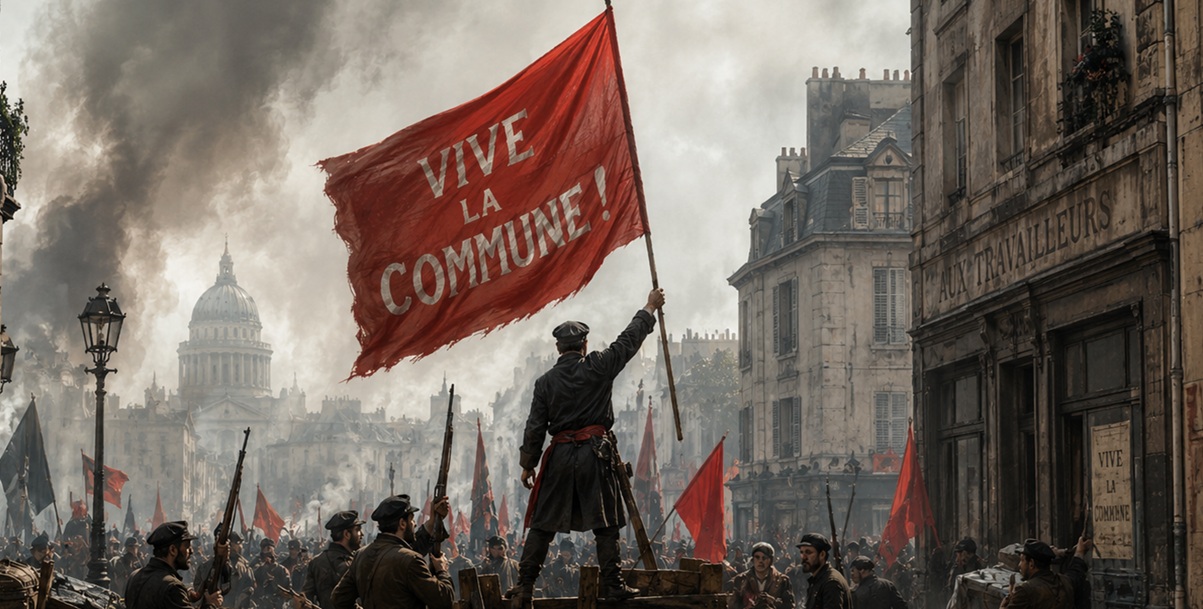
Human emancipation therefore signifies liberation not merely from one ruling class but from class society itself, including the political domination embodied in the state. This understanding becomes decisive in Marx’s interpretation of the Paris Commune. In The Civil War in France (p. 224) Marx praises the Commune because it aimed to abolish class property and reorganize production through associated labor: “If co-operative production is not to remain a sham and a snare … if united co-operative societies are to regulate national production upon common plan … what else, gentlemen, would it be but communism?”
The divergent historical conclusions Marx and Engels reached regarding the state serve as the entry point for a broader debate. While scholars often conflate the two thinkers on dialectics, Hegel, and Feuerbach, their theoretical frameworks differed considerably. This divergence is especially clear regarding the Communist Manifesto. While traditional scholarship reduces Engels to Marx’s mere assistant, historical reality suggests otherwise. Engels was actually the primary architect of the text, driving the conceptual development and authorship of the Manifesto, particularly its crucial second chapter, which he adapted directly from his three earlier drafts: “A Communist Confession of Faith” (June 1847), “The Principles of Communism” (Oct.-Nov. 1847), and a June 1847 pamphlet also titled “The Principles of Communism.”
In particular, the June 1847 pamphlet provides an early systematic outline of communist objectives. In Section 18 (pp. 91-92), Engels specifies the tasks of the revolutionary transition:
Limitation of private property through progressive taxation, heavy inheritance taxes … gradual expropriation of landowners, industrialists, railroad magnates and shipowners, partly through competition by state industry, partly directly through compensation in the form of bonds … confiscation of the possessions of all emigrants and rebels … organization of labour or employment of proletarians on publicly owned land, in factories and workshops, with competition among the workers being abolished … centralization of money and credit in the hands of the state through a national bank … [and] concentration of all means of transportation in the hands of the nation.
Similarly, in chapter 2 of Marx and Engels’ Communist Manifesto (p. 119, p. 126), the programmatic goal is stated as the “overthrow of bourgeois supremacy, [and] conquest of political power by the proletariat, centralization of all transportation, increase in the number of national factories, equal labor duty for all.” The Manifesto also notes that these tasks will “be different in different countries,” but generally include the “abolition of property in land… a heavy progressive or graduated income tax, abolition of all rights of inheritance… [and the] centralisation of credit in the hands of the state.”
In the 1872 preface to the Manifesto, Marx and Engels critiqued the document—particularly its second chapter—noting that its revolutionary measures had become antiquated. Following Marx’s death, Engels alone reiterated this critique in his final prefaces to the text.
Engels would later summarize this perspective in Socialism: Utopian and Scientific (p. 147): “The state is not ‘abolished.’ It withers away.”
Marx, however, arrived at a fundamentally different conclusion through his analysis of revolutions and especially the Paris Commune. In The Eighteenth Brumaire of Louis Bonaparte (p. 122), he argued: “All revolutions perfected this machine instead of breaking it.” Add citation
He later reaffirmed this in his April 12, 1871 letter to Ludwig Kugelmann (p. 247: “The next attempt of the French Revolution will be no longer … to transfer the bureaucratic-military machine from one hand to another, but to smash it.”
For Marx, genuine emancipation required not the gradual withering of the existing state machinery but its destruction. Every previous revolution merely transferred control of the state from one class faction to another while preserving bureaucracy, military hierarchy, and centralized political domination. The communist revolution therefore cannot inherit the bourgeois state apparatus. It must abolish it.
These contrasting statements reveal a crucial theoretical divergence between Marx and Engels. While Engels envisioned the state gradually dissolving as class antagonisms disappeared, Marx maintained that genuine emancipation required the destruction of the state apparatus itself. According to Marx, every earlier revolution—from 1789 to 1848—merely changed the hands that controlled the state without abolishing its underlying structure: its bureaucracy, standing army, and centralized machinery of power. Therefore, he argued, the proletarian revolution must take the opposite course—not to inherit or reform the existing state, but to abolish it altogether.
The antagonism between Marx and Engels regarding the state can be traced back to their fundamentally different starting points. Two key examples illustrating their contradictory approaches are found in works written in the same year, 1847—The Communist Manifesto and The Poverty of Philosophy. In the latter (pp. 173-174), Marx wrote:
An oppressed class is the essential condition for any society founded on the antagonism of classes. The emancipation of the oppressed class necessarily entails the creation of a new society. For the oppressed class to free itself, it is crucial that the productive forces and the existing social relations are no longer capable of coexisting. Of all the instruments of production, the most powerful productive force is the revolutionary class itself. The organization of revolutionary elements as a class requires the existence of all the productive forces that have been generated within the old society.
But does this mean that after the collapse of the old society, a new class domination will emerge, culminating in a new political power? No.
The condition for the emancipation of the working class is the abolition of all classes, just as the condition for the liberation of the third estate in the bourgeois order was the abolition of all estates and orders.
The working class, in its development, will replace the old civil society with an association that excludes classes and their antagonism. As such, there will no longer be any political power in the traditional sense, since political power is precisely the official expression of antagonism in civil society.
And in the first draft of The Civil War in France (p. 150), Marx said that the Paris Commune was “a revolution not against this or that, legitimate, constitutional, republican or imperialist form of State power. It was a revolution against the State itself, of this supernaturalist abortion of society, a resumption by the people for the people of its own social life.”
The communist revolution begins precisely where political economy ends.
References
Engels, Friedrich. Anti-Dühring: Herr Eugen Dühring’s Revolution in Science. Moscow: Progress Publishers, 1975.
Engels, Friedrich. “Draft of a Communist Confession of Faith.” In Marx and Engels Collected Works, Vol. 6. New York: International Publishers, 1976.
Engels, Friedrich. “The Principles of Communism.” In Marx and Engels Collected Works, Vol. 6. New York: International Publishers, 1976.
Engels, Friedrich. Socialism: Utopian and Scientific. In Marx and Engels Selected Works, Vol. 3. Moscow: Progress Publishers, 1970.
Lenin, Vladimir Ilyich. “Draft Programme of the Russian Communist Party (Bolsheviks).” In Collected Works, Vol. 29. Moscow: Progress Publishers, 1977.
Marx, Karl. Capital: A Critique of Political Economy, Vol. I: The Process of Production of Capital, trans. Ben Fowkes. London: Penguin Books, 1976.
Marx, Karl. Capital: A Critique of Political Economy, Vol. II: The Process of Circulation of Capital, ed. Friedrich Engels, trans. Progress Publishers. Moscow: Progress Publishers, 1956; originally English ed. 1907.
Marx, Karl. Capital: A Critique of Political Economy, Vol. III: The Process of Capitalist Production as a Whole, ed. Friedrich Engels, trans. Progress Publishers. Moscow: Progress Publishers, 1959; based on English transmission tradition used in Marxists Internet Archive editions.
Marx, Karl. The Civil War in France. In Marx and Engels Selected Works, Vol. 2. Moscow: Progress Publishers, 1969.
Marx, Karl. A Contribution to the Critique of Political Economy. Moscow: Progress Publishers, 1970,
Marx, Karl. Critique of the Gotha Programme. In Marx and Engels Selected Works, Vol. 3. Moscow: Progress Publishers, 1970.
Marx, Karl. Economic and Philosophic Manuscripts of 1844. In Marx and Engels Collected Works, Vol. 3. New York: International Publishers, 1975.
Marx, Karl. The Eighteenth Brumaire of Louis Bonaparte. New York: International Publishers, 1963.
Marx, Karl. Grundrisse: Foundations of the Critique of Political Economy. Translated by Martin Nicolaus. London: Penguin Books, 1973.
Marx, Karl. “Letter to Joseph Weydemeyer, March 5, 1852.” In Marx and Engels Selected Correspondence. Moscow: Progress Publishers, 1975.
Marx, Karl. “Letter to Ludwig Kugelmann, April 12, 1871.” In Marx and Engels Selected Correspondence. Moscow: Progress Publishers, 1975.
Marx, Karl. The Poverty of Philosophy. Moscow: Progress Publishers, 1955.
Marx, Karl, and Friedrich Engels. The German Ideology. New York: International Publishers, 1970.
Marx, Karl, and Friedrich Engels. The Holy Family, or Critique of Critical Criticism. Moscow: Progress Publishers, 1975.
Marx, Karl, and Friedrich Engels. Manifesto of the Communist Party. In Marx and Engels Selected Works, Vol. 1. Moscow: Progress Publishers, 1969.

Be the first to comment