

by Ralph Keller
Introduction
For decades, private organizations and governments have collected, stored and used a mass of personal data. While people have always resisted electronic data collection and processing, the resistance has now reached a new level because of the progressing Digitalzwang, i.e., governments and corporations increasingly forcing people into a digital and online life that comes with a mandatory provision of data including date of birth, name and address, health records, driving, tax, pensions, banking, insurance.[1] In addition, corporations help themselves to information stored on a person’s PC or phone (i.e., personal address books, call and chat histories, emails, browser histories, settings of websites visited, payment information, etc.), or online information generated on social media (e.g., Facebook, Signal, Snapchat, Telegram, WhatsApp, X, YouTube).
Whereas in the past such data was stored and processed for isolated purposes, and people had a choice with whom they shared their personal information, the progression of technologies underlying Digitalzwang accounts for the breaking down of the technical barriers to data sharing. This means that technology giants such as Apple, Google, Meta and Microsoft, as well as governments, now enjoy much greater freedoms to collect, process and share personal data. Firms and governments now secure these freedoms for themselves, by excluding people from access to the service, unless people give up whatever provision of personal data is deemed necessary.
More specifically, tech giants claim that the collection of masses of personal data is a prerequisite for providing a free service, or to improve said service in the future. Governments argue that a push towards mandatory age verification and digital government ID helps to tackle crime, e.g., protecting children from harmful web content. To facilitate this, Western countries now implement new laws according to which people must verify their age before being allowed to connect PCs or personal phones to the internet. In addition, the UK government and the EU have recently pushed for the introduction of mandatory digital ID. This is a system where the government holds a person’s date of birth, place of residence, and some biometric information, usually a photo or fingerprints, on a central database. People are then strongly encouraged to install an app on their phones which connects to that database to verify one’s identity, otherwise the service will be inaccessible.
However, people are increasingly fighting back against the ever-progressing Digitalzwang, by questioning the effectiveness of age verification measures, pushing back against the increasing risk of having personal data leaked (due to an organization’s carelessness, hacker attacks, of firms’ profit-seeking behaviors), or by openly expressing the sentiment that “our identity belongs to us, not the system”.
In this article I consider the challenges associated with Digitalzwang, including data breaches and privacy violations, and analyze the developing push-back in detail. I then discuss what I consider the missing element in the struggle against Digitalzwang: Karl Marx’s theory of alienated labor.[2] Rooted in Marx’s analysis that capitalist production turns people into mere appendages to machinery, I argue that people have now become appendages to IT in everyday life. In my view, this new process of alienation gives rise to the progressing Digitalzwang around the globe, which alienates people from their personal information and data. I then argue that this alienation constitutes the philosophical underpinning that explains why people fight back—in addition to increasingly seeing their privacy and online safety threatened. Finally, I propose future ways with which to fight the ever-progressing Digitalzwang.
What, Exactly, is Digitalzwang?
German activist group digitalcourage (they spell their name that way) recently coined the term Digitalzwang, which has the following characteristics (my translation with my examples added):
- Although technologically possible, an analogue alternative will no longer be available. This means that, without smartphones or PCs, some people will be excluded from public life. Examples include services offered by the state, such as the UK government forcing everyone to submit tax returns online.
- App-Zwang means that one must use an app to access certain services. Typically, these apps can only be installed if the person has a smartphone, uses a certain operating system and has access to that operating system’s app store. A case in point is that Western governments now push people towards using ID apps, such as the EU’s Digital Identity Wallet.
- Account-Zwang exists where a service is only available if one has set up a user account, for which personal data must be supplied. The UK government now pushes its One Login, where people simply log in to prove their identity. To enable One Login, one has no choice but to provide ID in the form of a passport or a driving license. The government then cross-checks that information with credit reference agencies.
- The Zwang to give up your personal information—it is becoming increasingly common for a service to be available only if a person accepts surveillance technologies, such as tracker cookies, key loggers or snooping bots. This is the case for Facebook, X, various messaging services, some web browsers, the Gmail email service, as well as operating systems released by Apple, Google and Microsoft (Microsoft Windows now goes as far as taking a snapshot of everything on your screen every few seconds).
The essence of Digitalzwang is that people are increasingly forced to provide personal data in digital form, which governments and private companies store, process and share. To push back, digitalcourage argues that “without the freedom to choose [between digital and analogue services], we will soon live in a world full of technology of abysmal quality that we can no longer avoid” (my translation). On these grounds, digitalcourage urges the German parliament to add to the nation’s constitution the right to live without Digitalzwang. If achieved, the addition would prevent the German state from restricting civil liberties by changing its relationship to ordinary people.
Take age verification to protect children for example. A change of the relationship between the German state and ordinary people would occur if people had to constantly prove that no law is being broken while online (no change would occur if the state had to prove, as has been the case thus far, that some law has indeed been broken). In terms of forced digital ID, the change in the relationship would be such that people no longer have the liberty to choose between a digital and an analogue option and thus can no longer exercise their right to privacy.
But Digitalzwang is not just happening in Germany. It is happening all over the world. Following this, enjoying the constitutional right to live without Digitalzwang would be beneficial for people not only in Germany, but for everyone across the globe.
Dangers of Digitalzwang for Ordinary People
Besides taking away civil liberties, the danger associated with Digitalzwang is that it puts people at risk of data breaches and privacy violations. Once such risk arises with the push towards government ID apps that are, contrary to government assurances, inherently insecure and unsafe to use. Indeed, following such an assurance by Ursula von der Leyen, President of the European Commission, the EU’s Digital Wallet app was hacked in only two minutes. This prompted concerns that the app may be insecure by design, and so it will be easy for law enforcement to access the data on people’s phones. Further, in 2022, an IT provider of the National Health Service in the UK was held to ransom and forced to release patient records controlled by hackers.
 Credit: gov.uk
Another fear arising with forced digital ID is the possibility that law enforcement or the government could misidentify a person. Indeed, in India for example, people allegedly died because they were unable to access their grain allowance because digital ID was unavailable or fingerprints could not be verified. In the UK, there have been reports that eVisa holders were wrongly denied access to healthcare, and recognized refugees were unable to open bank accounts or access housing.
Safety and security concerns also exist in the private sector. For example, Discord, a popular instant messaging and VoIP[3] platform, recently experienced a data breach where “an unauthorized party” gained access to Discord’s third-party customer support. Another example is the data breach at USS,[4] a pension plan provider in the UK, where in 2023 hackers targeted Capita, USS’ technology supplier. Names, dates of birth, retirement dates and National Insurance numbers were leaked, putting clients at risk of identity theft. Or there was the data breach at Eurail, a travel pass that permits rail travel across 33 European countries. Eurail’s database was hacked, affecting 300,000 travelers who had their passport numbers, names, phone numbers, email and home addresses stolen. Travelers were advised to cancel their passports and apply for new ones, at their own expense, of course.
Besides being exposed to online risk, another major issue is the way in which Western governments are now pushing to protect children from harmful web content. By banning under-16s from accessing services such as Facebook, Instagram, Snapchat, Threads, Tiktok, X and others, many countries now follow Australia’s lead in implementing new laws that govern social media use that force people to give up their personal information. For example, the UK’s 2023 changes to the Online Safety Act mandates that “[p]latforms are required to use secure methods like facial scans, photo ID and credit card checks to verify the age of their users … without collecting or storing personal data, unless absolutely necessary” (emphasis in original). Likewise, California was the first US state to mandate online age verification if people want to access online services, and similar legislation is now being pushed in other states and at federal level.
However, empirical data casts doubt on the effectiveness of mandatory age verification. A survey by the Molly Rose Foundation revealed that, following the ban, 60% of Australian children continue to use social media. In the UK, research by internetmatters.org indicates that “[a] third (32%) of children [in the study] have bypassed age checks by using methods like entering a fake birthday or even drawing on facial hair” and “[a] quarter (26%) of parents [in the study] have allowed their child to bypass age checks” (my translation). OFCOM, the UK’s communications regulator, concludes in this context that “we have seen some early signs of improvement” (p.24), “[b]ut there is a great deal more to be done, and new technology and content trends pose additional risks” (p.3). This is a diplomatic way of saying that the UK’s “Online Safety Act” works only to a very limited extent. In light of the evidence, it looks as if age verification, at least in the UK and Australia, drives access to harmful online content underground, but does not resolve the issue.
How and Why People Fight Digitalzwang
YouTube channels such as Cyber Waffle, The Landuke Journal or The Morpheus, or individuals initiating government petitions, push back against age verification and digital ID, by attacking Digitalzwang on mainly two fronts. The first is the risks to safety and security that people cannot control, and which instead controls people. The second is the paternalistic and invasive nature of age verification—for example, in this petition in the US; or in this petition in the UK, which aimed to stop the mass surveillance introduced by mandatory digital ID. Similarly, the Institute of Development Studies argues that “most countries lack an adequate legal framework to ensure that digital-ID systems protect human rights”, and that “no country has … established conclusively that … digital-ID meets the test of being ‘legal, necessary and proportionate’”.
Other forms of push-back include individual people not updating their phones or gaming consoles to avoid age verification added to the latest firmware revision. Moreover, developers of Linux distributions indicate that they do not intend to implement age verification. The developer of Slackware Linux went as far as stating that his code constitutes free speech, and that the need to implement age verification violates his right to free speech.
People also use Virtual Private Networks (VPNs) to circumvent age verification. This works because a VPN tells a website with age restricted content that the user is located in a country not requiring age verification. This means that people in the West are now using VPNs in the same way that people in oppressive regimes have for years. In response, governments (for example in the UK) now discuss banning VPNs, but the Labour Government for now will not go ahead with the plan. This is most likely because a VPN ban would be technologically impossible to enforce.
Broadly speaking, people push back because they see progressing Digitalzwang, pursued by governments around the world, as a violation of privacy and security. In other words, opponents see age verification, which allegedly protects children, and digital ID as a restriction of individual rights and freedoms. In addition, people push back because they have realized that, even if digital ID and age verification laws forbid “collecting or storing personal data, unless absolutely necessary”, we will always experience data breaches due to hacker attacks or firms unlawfully collecting and selling personal data for profit.
The Missing Element in the Struggle Against Digitalzwang
Fighting the ever-progressing Digitalzwang is a tall order because governments and tech giants hold the power here. This situation, paired with governments not having satisfactorily solved the legality and the necessity of Digitalzwang, will make it challenging for individuals to hold governments accountable for data breaches. In addition, governments forge agreements and contracts with large corporations that collect, store and process people’s digital data. Other firms also wield their economic power, helping themselves to more personal information through controlling the operating systems people use on their phones and PCs—I am looking at Apple, Google, Microsoft and Sony. Tech giants repeatedly violate consumer’s privacy rights despite trying to appease users with flowery phrases like “we care about your data and keep it safe”. If this were true, then I wonder: why do they help themselves to our data in the first place?
In light of this power, another way of fighting back is required in addition to the struggle that people already engage in. The question is, however, what should this fight be based on? I propose that the basis of this fight should be the deeper philosophical understanding of Digitalzwang rooted in Marx’s concept of alienated labor. Table 1 summarizes Marx’s arguments and details my application of his views to Digitalzwang, on which I elaborate below.
| Alienated Labor | Alienation arising from Digitalzwang |
| Workers do not control the machine in terms of economic decision-making[5] | · People own smartphones, PCs, gaming consoles, smart TVs, etc. in the legal sense, but increasingly lose control over these devices in terms of decision-making
· Ordinary people do not control the wider IT infrastructure (e.g., the internet, servers, software) · By law and legislation, governments protect digital data collection, storage, processing and sharing |
| Workers do not control the process of production and thus become alienated from it | · People increasingly lose control over how devices function and how they are to be used
· Thus, people increasingly become alienated from functioning and use of devices |
| Because workers do not control the production process, they also do not control the product of their labor and thus become alienated from it[6] | · People increasingly lose control over collection, storage, processing and sharing of their personal data
· Thus, people increasingly become alienated from that data |
| Consequence: in production, workers become a mere appendage to the machine and are being treated as such | Consequence: in every part of life, people become a mere appendage to IT and are increasingly being treated as such |
Table 1: Alienated labor and alienation arising from Digitalzwang
Loss of Control over the Machine and Personal Devices
In Capital, Volume I, Marx argues that “from the moment that the tool proper is taken from man, and fitted into a mechanism, a machine takes the place of a mere implement. The difference strikes at once, even in those cases where man himself continues to be the prime mover [of the machine]” (p.261). In Dunayevskaya’s words (2000), the situation is such that “[t]he worker … lost his individual skill to the machine” (pp.92f). Put another way, capitalists have taken economic control of the machine, and therefore the skill embodied in it, and use that control to exert power over workers.[7] The machine has thus become the material instrument of capitalist power, but, in my view, is no longer the only instrument.[8] In addition, because people do not control personal devices and IT infrastructure, these have become another instrument of power alongside the machine.
How Alienation from Labor, as well as from Function and Use of Personal Devices, Arise
In his essay on alienated labor, Marx argues that labor appears external to the worker and “that in his work”, man “does not affirm himself but denies himself, does not feel content but unhappy … . The worker therefore only feels himself outside his work … . His labor is therefore not voluntary, but coerced”. This makes labor appear external and alien, and “the external character of labor for the worker appears in the fact that it is not his own … that it does not belong to him … but to another”. In other words, if the worker treats his labor “as an unfree activity, then he treats it as an activity performed in the service, under the dominion, the coercion, and the yoke of another man”. “Just as he estranges his own activity from himself, so he confers upon the stranger an activity which is not … [the stranger’s] own”.
Strikingly, Marx’s argument still holds if we replace “labor” with “function and use of personal devices”! Function and use of personal devices become activities that are increasingly external and alien—because function and use are not under the control of the people who own the devices. Instead, function and use are performed “in the service, under the dominion, the coercion, and the yoke” of tech giants and governments. The fact that people increasingly push back against Digitalzwang is evidence of this alienation.
How Alienation from the Product of Labor and Personal Data Arise
Marx proceeds to explain alienation from the product of labor on the basis of alienation from the activity of labor, as: “in the estrangement of the object of labor is merely summarized the estrangement, the alienation, in the activity of labor itself”. Put another way, alienation from the activity of labor manifests itself in the object of labor. Thus, “the object which labor produces—labor’s product—confronts … [labor] as something alien, as a power independent of the [worker]. The product of labor is labor which has been embodied in an object, which has become material: it is the objectification of labor. Labor’s realization is its objectification. Under these economic conditions objectification [appears] as loss of the object and bondage to it; appropriation [appears] as estrangement, as alienation (emphasis in original).”
Thus, the product of labor appears as an alien object to the workers, and this object exercises power over them. Specifically, Marx argues:
If the product of labor does not belong to the worker, if it confronts him as an alien power, then this can only be because it belongs to some other man than the worker. If the worker’s activity is a torment to him, to another it must give satisfaction and pleasure. Not the gods, not nature, but only man himself can be this alien power over man. … Thus, if the product of his labor, his labor objectified, is for him an alien, hostile, powerful object independent of him, then his position towards it is such that someone else is master of this object, someone who is alien, hostile, powerful, and independent of him (emphasis in original).
It is again striking that Marx’s argument still holds if we replace “product of labor” with “collection, storage, processing and sharing of personal data”. These characteristics of Digitalzwang increasingly “give satisfaction and pleasure” to tech giants and governments, so that digital data increasingly opposes people as “alien, hostile, powerful object independent of” people. The result is that people become alienated from their personal data.
I am not arguing that alienation arises merely because our data is now digitalized. I am arguing, however, that we become alienated because we increasingly lose control over the personal data that is being collected, stored, processed and shared. The farther Digitalzwang progresses, the greater the degree of alienation will be, and the more of a servant to their objectified data people will become.
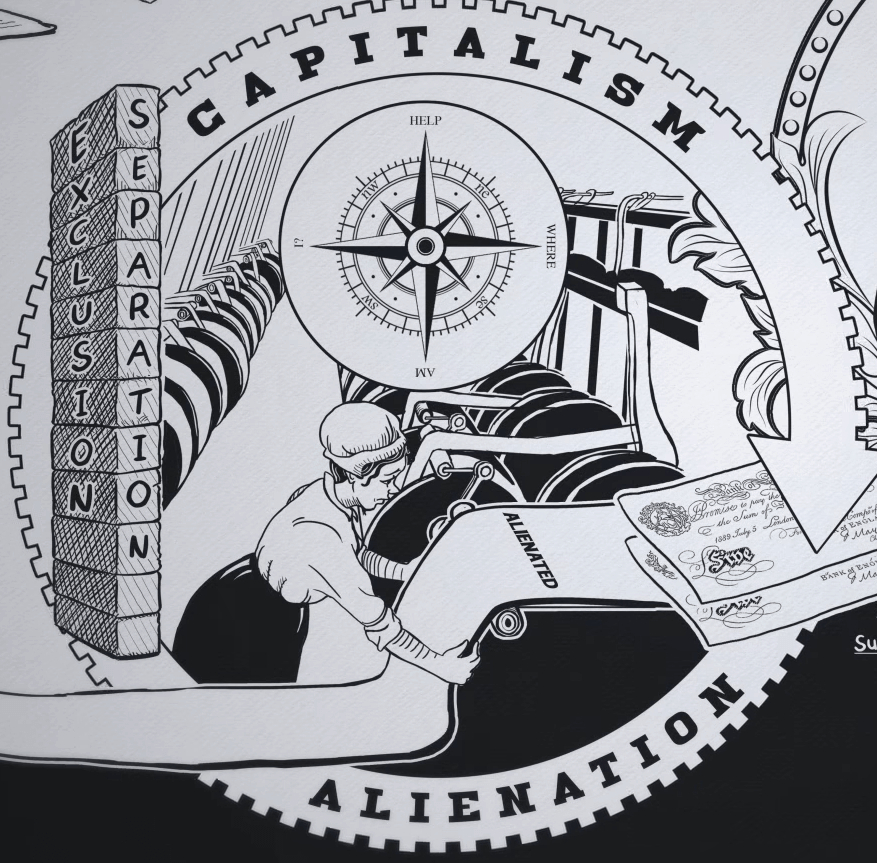
A caricature about alienated labor. Credit: University of Notre Dame
The Consequences of Alienation
Becoming an appendage to the machine, “the worker”, in Marx’s words, “sinks to the level of a commodity and becomes indeed the most wretched of commodities”. Being an appendage to personal devices and IT infrastructure enables governments and tech giants to help themselves to our personal data, commodify it and derive profits from processing and selling it. The consequence of this commodification is ever-increasing Digitalzwang, which brings with it the surveillance and control of people’s very identity and activity outside of work. Lives have been transformed into a means for the self-development of technology outside of work—technology no longer serves human development; people serve technological development, in a process analogous to the alienation of labor.
Mankind now exists for the purpose of providing data as well as labor. As Marx argues in his essay on alienated labor, people no longer exist as social beings that relate naturally to one another.[9] Instead, people relate to each other as object beings, in production as well as everyday life. Not only do governments today protect Digitalzwang by law and legislation, they also outsource collection, storage, processing and sharing of that data to tech giants driven by the objective purpose of capital itself: its ceaseless self-expansion and relentless pursuit of profit.[10] This explains, in my view, why governments now push hard when rolling out age verification and digital ID: they most likely have agreements and contracts in place with technology companies because outsourcing to private firms is commonplace under capitalism.
The Future of Fighting Digitalzwang While Also Protecting Children
Without referencing Marx’s theory, digitalcourage some time ago recognized the practical implications of alienation that arises from Digitalzwang: people who are constantly being watched are not free people at all. More recently, GamersNexus Consumer Advocacy has argued that age verification is but a form of digital ID, which further intensifies the degree with which governments and tech giants make use of people’s personal data. This is especially troubling given the struggle against Digitalzwang has recognized that an effective alternative to age verification already exists: empowering parents to stop their children from accessing harmful online content by setting up parental controls on home routers and mobile phones. It only takes 20 seconds or less to do so. In other words, it only takes 20 seconds or less to protect one’s child without alienating everyone. The UK government is aware of the effectiveness of parental controls, yet still chooses to push ahead with digital age verification. Nevertheless, its implementation has reportedly been postponed for three years amid widespread push-back.
Digitalzwang, and with it the alienation from personal data, changes the nature of the relationship between individual people and the state: instead of the state having to prove that an individual has committed a crime, individuals now have to prove that to the state they did not commit a crime. Yet without satisfactory legal systems in place that allow challenging governments and tech giants on legal grounds for privacy violations and exposing people to online risk, it is currently difficult to hold anyone to account (although legal challenges against tech giants have met with the occasional success).
Another way to fight against Digitalzwang is to avoid engagement with digital technology altogether and use only analogue means of communication. However, this direction might not be available in the near future as Digitalzwang progresses. It thus seems inevitable that the struggle against the alienating use of digital technologies will continue in the following forms: i) refusing to update a device’s firmware to the latest version that includes ID verification; ii) using operating systems such as Linux, and web browsers that do not spy on people; iii) using a VPN service; or iv) using character models from video games to trick facial recognition.
However, in light of alienation arising from Digitalzwang, the conventional forms of resistance against tech giants and governments have become insufficient. To achieve freedom from alienation, the struggle against Digitalzwang must also ask, analogous to the 1949–50 West Virginia miner’s struggle against man-killing automation (Dunayevskaya, 2000), the question of what relationship should societies and people have with IT?[11] Interestingly, opponents of Digitalzwang have already provided a partial answer to this question, by demanding to maintain control over their devices. This is a revolutionary demand that challenges the capitalistic use of IT. But to overcome this use entirely requires nothing short of the uprooting of the capitalist mode of production, as people under capitalism are a mere means to an alien end—in the realm of production and now in their everyday lives.
Reference
Dunayevskaya, R. (2000). Marxism & Freedom: From 1776 Until Today. New York: Humanity Books.
Notes
[1] “Zwang” is German for coercion.
[2] The German original title of Marx’s essay is “Entfremdete Arbeit”, which translates as “Estranged Labour”. Yet “estranged” somewhat insufficiently conveys what Marx meant, so “alienated” is the stronger translation. Lacking a word for alienation, the Chinese language describes it as separation and distance, which aptly captures the essence of the concept.
[3] Voice over Internet Protocol.
[4] Universities Superannuation Scheme.
[5] Control in terms of economic decision-making differs from working with the machine in a production sense, and from maintaining or repairing the machine in an engineering sense. Economic control also differs from legal ownership; capitalist laws in the legal sense protect, but do not enable, economic control.
[6] Critics of Marx might apologetically argue that workers are not interested in exercising economic control. However, a lack of interest is merely the way in which alienated labor asserts itself.
[7] This hallmark of the capitalist mode of production arose with the division of labor in Britain’s 16th century workhouses.
[8] See Marx, Capital I, chapter 15.
[9] China is far ahead of Western countries with its Social Credit System, which many consider a tool for total surveillance by the state. A government slogan is: “keeping trust is glorious and breaking trust is disgraceful”. The Chinese government might argue that this slogan does not refer to survey lance, but to the lack of trust in day-to-day business relations.
[10] Pursuing profit is not merely a subjective, unethical, attempt to become rich at the expense of workers. Instead, the pursuit of profits corresponds to an underlying, objective, purpose that arises with the workings of capital itself; that is, “a purpose that stems from the structure and operation of the capitalist economy” (see Andrew Kliman’s July 9, 2021, comment).
[11] This is analogous to the 1949-50 West Virginia miner’s strike against the introduction of man-killing automation, when miners posed the question of “what kind of labor should man do?” (Dunayevskaya, 2000).

Be the first to comment