

by Andrew Kliman
Background
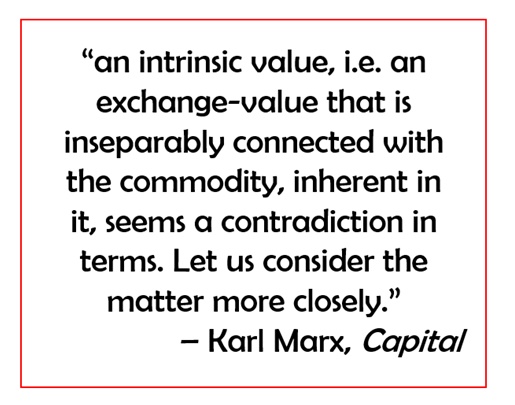
In an essay published in 2000 that discussed Marx’s development of the concept of “intrinsic value”—that is, value as distinct from “exchange-value”—I provided a new interpretation of what I called Marx’s “third thing” argument, which appears near the start of Capital, Volume 1. His argument, which has always been, and remains, highly controversial, seeks to demonstrate that a commodity has an intrinsic value as well as exchange-values. The term “third thing” refers to the argument’s key conclusion that any two commodities that are exchangeable with one another are “equal to a third thing [einem Dritten], which in itself is neither the one nor the other” (Marx 1990, p. 127 of Penguin ed.). On the next page, Marx calls this third thing “value.”
A few years later, a paper by James Furner took issue both with Marx’s third thing argument and with the argument I offered in defense of it. Soon thereafter, a paper by Patrick Murray defended and elaborated upon what he took to be my argument, and it offered his own interpretation and defense of Marx’s third thing argument. In an unpublished response written in 2008, “The Fourth Thing on the Third Thing: A Response to James Furner and Patrick Murray,” I argued that both of them had misinterpreted Marx’s argument as well as my defense of it.
The present article is a slightly revised version of portions of my response that clarify my interpretation of Marx’s argument and contrast it to Furner’s and Murray’s interpretations. Its centerpiece is an 18-step proof of Marx’s conclusion that “exchange-value cannot be anything other than the mode of expression, the ‘form of appearance,’ of a content distinguishable from it”—that is, the “form of appearance” of a third thing, namely value. My proof fills in many of the steps in the argument that Marx’s own, much terser proof left implicit. In contrast to both Furner and Murray, I regard Marx’s argument as a sound deductive argument in which the existence of intrinsic values is derived on the basis of nothing more than a couple of unexceptionable facts and the common meanings of the terms employed in the argument. The expanded proof I offer is my effort to demonstrate this claim.
The Expanded Proof
The following table, a sketch of the logical structure of the first paragraph of the third thing argument, provides my interpretation of what Marx was doing. Because several aspects of the paragraph have proven to be quite controversial, I have supplemented the argument as it appears in his text with several additional steps in order to make the logic of the paragraph more perspicuous. However, I am not suggesting that the table replicates Marx’s conscious thought process.
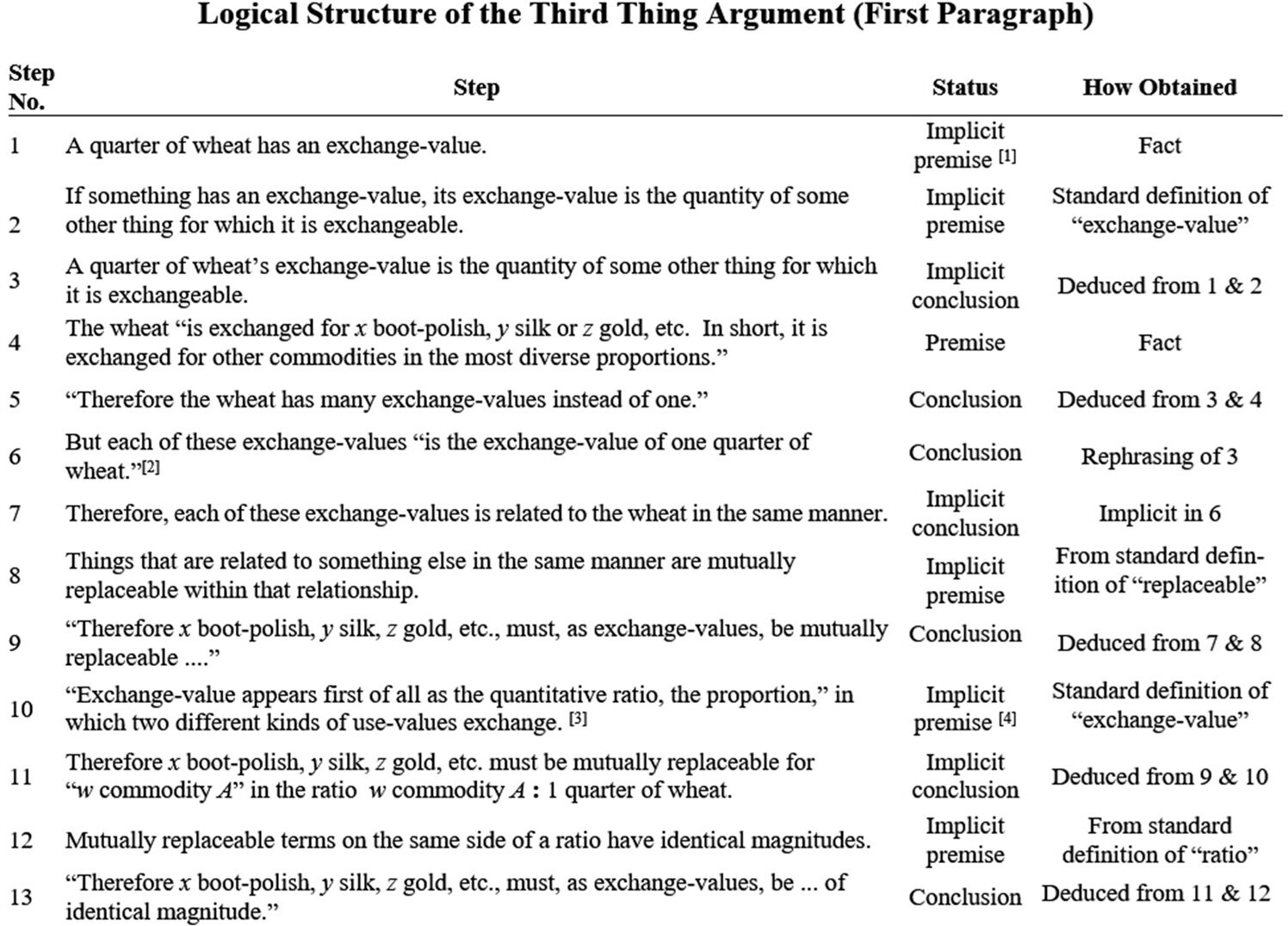
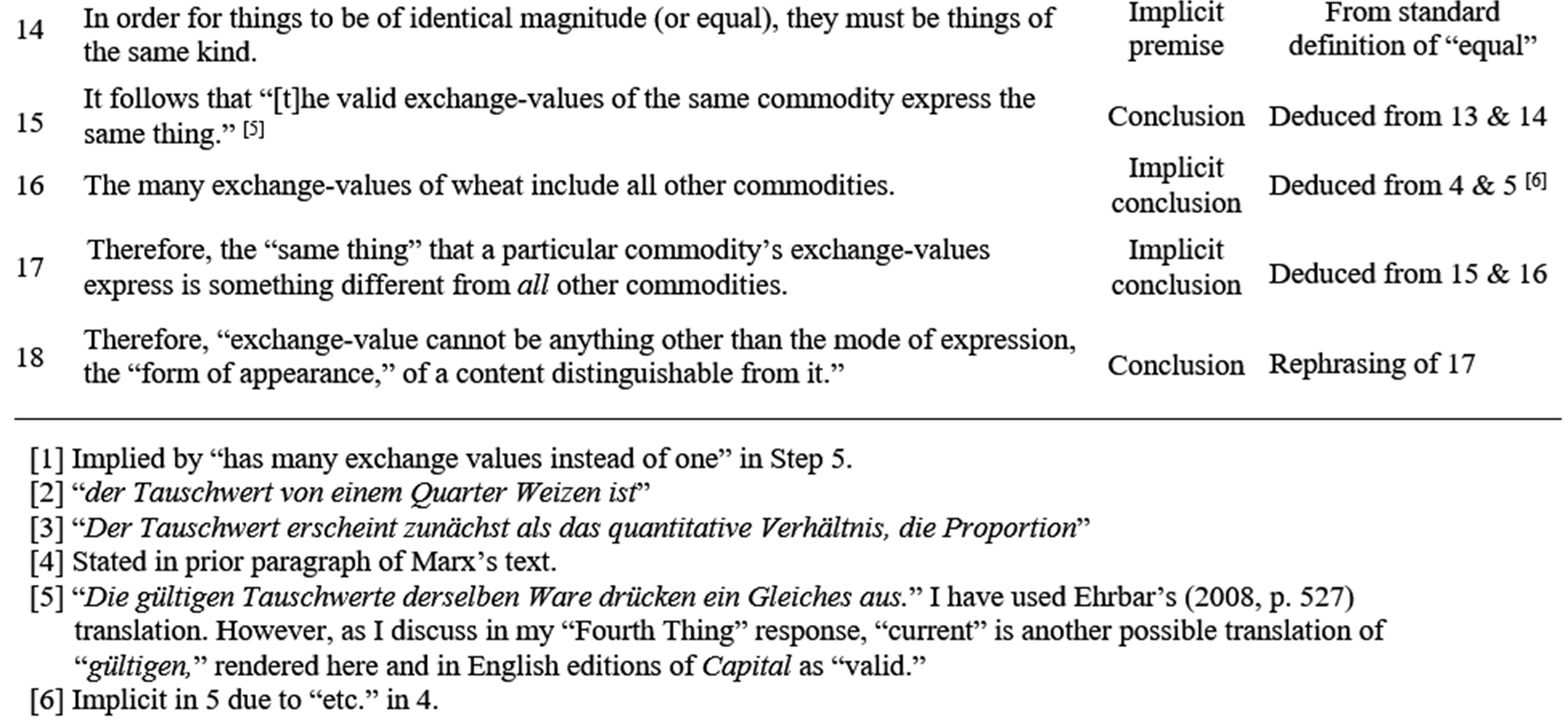
On my interpretation, Marx’s initial premise, Step 1, is the fact that the quarter of wheat has an exchange-value. As I argue in my “Fourth Thing” response, this should be understood to mean that the wheat has a relative value (such as a price). Its relative value is the particular amount of some other commodity (such as gold) for which the quarter of wheat is exchangeable; the first commodity has this relative value whether or not it is actually exchanged with the second commodity. Marx deduces his conclusions on the basis of this fact, the additional fact that wheat is exchanged for many other commodities (Step 4), and standard definitions of a few words––“exchange-value” (Steps 2 and 10), “replaceable” (Step 8), “ratio” (Step 12), and “equal” (Step 14).
The table above helps to clarify a point I made elsewhere in my “Fourth Thing” response as well as my initial essay: the third thing argument does not succeed if “has an exchange-value” is taken to mean merely “exchanges with some quantity of another commodity.” In that case, “the exchange-value of one quarter of wheat” would mean “the quantity of some commodity with which one quarter of wheat exchanges,” so Step 6 would become “But each of these quantities of other commodities with which one quarter of wheat exchanges is a quantity of another commodity with which one quarter of wheat exchanges.” That is a tautology from which nothing more can be deduced. Whereas Step 6 brings out a sameness among the exchange-values of wheat that allows Marx to derive their mutual replaceability in Step 9, the revised Step 6 does not.
Contrasts to Furner’s and Murray’s Interpretations
Furner (p. 94) charged Marx with “assuming A [the existence of intrinsic value] to prove B [the equality of commodities as exchange-values] and then taking B to prove A.” In contrast, my view is that Marx relied on two facts and four standard definitions to deduce both B (Step 13) and A (Step 18). Thus, he was not guilty of assuming A in order to prove B.
Furner and I agree about the next paragraph of Marx’s text: he began with B in order to arrive at A. Yet, on my interpretation, this is exactly what he did in the first paragraph, in moving from Step 13 to Step 18. Since the argument proceeds in the same direction in both paragraphs, he was not arguing in a circle. At worst, Marx was guilty of repeating himself. However, the apparent repetition serves a purpose. The first paragraph considers a series of commodities while the second paragraph considers just two. It is more difficult to recognize the existence of a third thing in the latter case. Thus, “once the equal content of a series of commodities is established, the equal content of two commodities can then be recognised more easily” (Kliman 2000, pp. 102–03, emphases in original).
Although Furner (p. 90, p. 107) rejected the third thing argument, he approved of the concept of intrinsic value, and he attempted to defend it by employing “systematic dialectics.” Insisting that “Marx’s theory of value [… is neither] an axiom or a piece of analytical reasoning,” he argued that “the proof of an intrinsic conception of value is to be found in the later development of more complex categories” (money and capital), not in the third thing argument.
On my interpretation, in contrast, the third thing argument is precisely “a piece of analytical reasoning,” and one that provides a valid “proof of an intrinsic conception of value.” It is not axiomatic, since it proceeds on the basis of empirical facts and standard (lexical) definitions, not on the basis of axioms, assumptions, or stipulative definitions. But apart from the two facts with which it begins, the argument’s first paragraph is entirely deductive. It does not appeal to “more complex categories.”
Murray (p. 155) contended, in effect, that the success of the third thing argument rests on a number of empirical claims that Marx did not make explicit. He argued that Marx’s (implicit) initial premise was that a commodity has a “valid” exchange-value or price. And “valid” prices—in Murray’s sense—have equilibrium-like properties––lawfulness, regularity, and constancy in the midst of fluctuations: “if there were no regularity to price fluctuations––if the law of value did not force its way through—there would be no ‘valid’ exchange-values. … Without observable constancy in the fluctuations of prices, Marx’s ‘third thing argument’ cannot be made.”
On my interpretation, however, the third thing argument relies on two facts only: a commodity has an exchange-value (whether “valid” in Murray’s sense or not) and it is exchanged for many other commodities. It does not appeal to any other features of the real world. I submit that, given these two elementary facts and the standard definitions of the terms that Marx employed, his conclusions follow necessarily. Thus, the conclusions hold true in the general case, not only in the special case in which prices have equilibrium-like properties. By making Marx’s conclusions dependent on a premise that is much more restrictive than necessary, and much more restrictive than Marx’s actual premise, Murray unnecessarily weakened the third thing argument considerably.
Conclusion
Once close attention is paid to the term “exchange-value” (or “value in exchange” as well as other synonyms) as it was employed in classical political economy, the third thing argument, though profound in its implications, seems to me to be easily understandable and ultimately simple. Given the standard meaning of “exchange-value” that Marx inherited, namely the ratio in which two kinds of use-values exchange––for example, w commodity A : 1 quarter of wheat––one only needs to “take a baby step” to arrive at the conclusion that the various quantities of commodities that can replace each other on the left side of the ratio “_____________ : 1 quarter of wheat”—that is, the wheat’s various exchange-values (w commodity A, x boot-polish, y silk, z gold, etc.)—are “of identical magnitude.” And after another baby step, one arrives at the existence of a third thing. Rather than trying to pull a rabbit out of the hat by deriving the equality of commodities from a non-quantitative relationship such as exchange, Marx was showing that one quantitative relationship implies another closely related one.
Reference
Ehrbar, Hans G. 2008, “Glossary to Marx’s Capital and Other Economic Writings.”

Thank you for the explanation! I am curious about three potential difficulties with this answer, or with Marx’s general form of argument.
Firstly, given this structure of the argument, how do we account for some thing shaving exchange-values but no value, like untouched land? That seems to undermine the idea that this exchange-value requires a third thing.
Secondly, and relatedly, how do we make the case for this third thing being labor rather than utility? Use-values are qualitatively different, of course, so a quarter of wheat will not have the same use-value as x amount of gold, but different forms of concrete labor are also qualitatively different and that doesn’t seem to pose a problem.
Thirdly, if we arrive at the idea of value by identifying each side of an exchange as expressing something equal, how do we understand this when Marx reveals later in Volume 3 that exchange-value/price will systematically deviate from value due to the tendency of the rate of profit to equalize? It seems like we are deriving the idea of value from pointing out that exchange implies equality, and then using this idea of value to argue how exchange isn’t equal at all.
Thank you to anyone interested in these questions or can provide good sources around this. I have read Diane Elson’s “Value Theory of Labour” and thought it was a decent attempt at answering this, but I always like to hear more thoughts.
“thing shaving” should be “things having”
I don’t think that “exchange-value requires a third thing.” I discussed that in my 2000 paper on Marx’s concept of intrinsic value. A crucial step in Marx’s argument is that the wheat or whatever has many exchange-values instead of one. Also, he is explicitly investigating commodities at this point in the argument. Unimproved land isn’t a commodity, so it can be set aside (temporarily–for the purpose of this particular argument that commodities have intrinsic values as well as exchange-values).
“different forms of concrete labor are also qualitatively different and that doesn’t seem to pose a problem”–I think it poses a big problem, and the exact same problem. It’s why Marx uses one argument to dispose of both use-values and concrete labors:
“If we make abstraction from its use-value, we abstract also from the material constituents and forms which make it a use-value. It is no longer a table, a house, a piece of yarn or any other useful thing. All its sensuous characteristics are extinguished. Nor is it any longer the product of the labour of the joiner, the mason or the spinner, or of any other particular kind of productive labour. With the disappearance of the useful character of the products of labour, the useful character of the kinds of labour embodied in them also disappears; this in turn entails the disappearance of the different concrete forms of labour.”
“Thirdly, if we arrive at the idea of value by identifying each side of an exchange as expressing something equal, how do we understand this when Marx reveals later in Volume 3 that exchange-value/price will systematically deviate from value due to the tendency of the rate of profit to equalize?” The key thing to grasp, which almost no one does, is that the equality of the two commodities is a premise of the argument. I dealt with this, too, in my 2000 paper, and, in my commentary on Edwards & Leiter’s book https://marxisthumanistinitiative.org/economics/have-no-time-to-believe-edwards-leiter-on-marxs-economic-thought.html , I quoted what I had written: Marx “derives the existence of intrinsic value from a postulated exchange of equivalents, not the converse. … [He] proceeds from the exchange of two equivalent commodities to derive their equality to a third thing: if ‘1 quarter of corn = x cwt of iron,’ then a common element of ‘identical magnitude’ exists in each. ‘If A, then B’ does not imply ‘if B, then A.'”