

by Theresa Henry
In 1943, the Soviet journal Pod Znamenem Marksizma (Under the Banner of Marxism) published an article titled “Some Questions of Teaching Political Economy.” Among other points, the article argued that the law of value operated in socialist societies, enabling the authors to claim that the USSR was socialist while admitting, in Joseph Stalin’s words, that “the law of value ha[d] not been overcome” (p. 17).[1] This was, and remains, a controversial argument. The idea that the law of value operates in a socialist society does not fit well with Karl Marx’s rejection of “the presupposition that the theory of value, developed for the explanation of bourgeois society, has validity” outside of the analysis of “bourgeois relations.”
The Soviet economists were thus in a bind. To make their argument while upholding the image of the Soviet Union as Marx’s “scientific socialism” incarnate, they had two options: (a) distort Marx’s writings to “prove” that the law of value operates in non-capitalist societies, including socialist ones, or (b) truthfully interpret Marx’s writings and acknowledge that the USSR was a capitalist society, at least according to Marx’s conception. Archival evidence released since the collapse of the USSR has confirmed that the Soviet economists pursued the first option under Stalin’s direct orders.
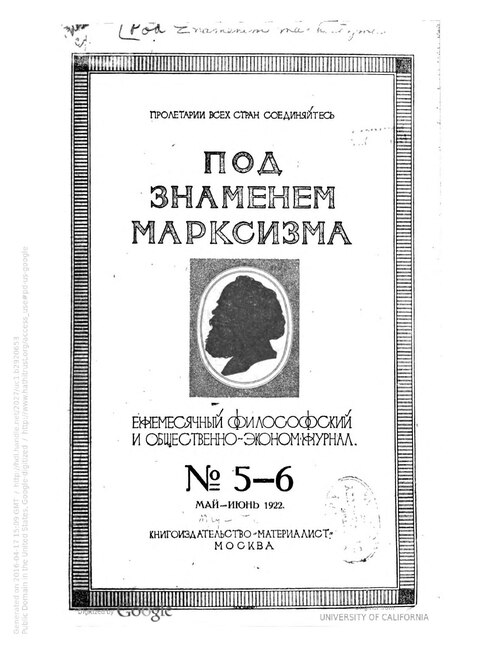
Pod Znamenem Marksizma (Under the Banner of Marxism) was a Soviet journal published in Moscow from 1922 to 1944. Credit: Wikipedia.org.
Although this revision of Marxian economic thought took place over 80 years ago, Stalin has long been dead, and the Soviet Union has since fallen, the 1943 revision remains relevant for at least two related reasons. First, this controversy concerns the concept of socialism—what “socialism” means, and, ultimately, what socialism is. This matters because, insofar as socialist revolutionaries are trying to realize their concept of socialism, it is that concept that guides their actions. Thus, this controversy concerns what kind of society would result if the revolutionary movement were to realize a particular concept of socialism. Second, views similar to those presented in the Soviet revision continue to prevail in the Marxist movement. By understanding the problems with the 1943 revision, we thus gain insight into the errors of contemporary Marxist thinkers and tendencies.
I will argue that, while workers would continue to be exploited if the prevailing concepts of socialism advanced in the Marxist movement today were realized, workers would no longer be exploited if Marx’s concept of socialism were realized. Put frankly, I will use the Soviet revision to help clarify that the contemporary Marxist movement is an obstacle to realizing its own professed goal: the self-emancipation of the proletariat.
To this end, I will discuss the Soviet reversal of Marx’s claim that “critique measures the individual existence by the essence, the particular reality by the Idea” and argue that this reversal resulted in the equation of the concept of socialism with the reality of state-capitalism (Section A). I will then show how this reversal leads to a theoretical regression that necessarily emphasizes the mode and relations of distribution over the mode and relations of production (Section B). Further, I will elaborate on the consequences of this theoretical regression, which is common in the Marxist movement (Section C). Before concluding, I will describe four ways in which Marx’s concept of socialism differs from those that prevail today, and show that it entails a society where workers are no longer exploited (Section D). I will conclude by emphasizing the importance of defending Marx’s concept of socialism.
A. The Equation of Socialism and State-Capitalism
“Critique,” Marx insisted in his notes for his 1841 doctoral dissertation, On the Difference Between the Democritean and Epicurean Philosophy of Nature, “measures the individual existence by the essence, the particular reality by the Idea” (p. 85). In 1943, Stalin directed a group of leading Soviet economists to do the opposite. He told them to measure the Idea of socialism by the particular reality of the USSR:
If you search for the answer to everything in Marx, you’ll get off track. In the USSR you have a laboratory that has existed for more than 20 years, and you think that Marx should know more than you do about socialism … You need to work with your own heads and not string together quotations. There are new facts and a new combination of forces. Be so kind as to work with your heads [p. 23].
Here, I think it is worth pausing on Stalin’s methodological advice. He first tells the Soviet economists that Marx’s theorizing about socialism will push them “off track,” implying that they should not appeal to Marx’s concept (or Idea) of socialism. He then suggests that they know more about socialism than Marx knew, because they have experienced the particular reality of the USSR, which they call a socialist society, and which has “new facts and a new combination of forces” that Stalin presumes Marx could not have known. In short, Stalin is telling the Soviet economists to base their concept of socialism on what they saw in the Soviet Union.
And this is exactly what the authors of “Some Questions of Teaching Political Economy” did. In Raya Dunayevskaya’s words, the 1943 Under the Banner of Marxism article proceeded “from the empirical fact of the existence of the USSR,” assumed “socialism [was] irrevocably established,” and then propounded “certain ‘laws of a socialist society.’”
Stalinists, and whoever else, are free to define socialism however they want. However, there are serious problems with Stalin’s method of determining what socialism is. Clearly, it put the Soviet economists in the bind I described in the introduction. In fact, at least one of the Soviet economists mentioned a problem with suggesting that the law of value operates in a socialist society: “Up until now the law of value was described as a law of the spontaneous market, determining also the spontaneous distribution of the labor force” (p. 22). Further, this method strips socialist thought of its critical element by depriving it of a concept of socialism that is not dictated by what already exists. For example, because what already existed in the USSR was state-capitalism, this method equated the concept of socialism with the reality of state-capitalism.[2] Consequently, this method has helped to obscure what distinguishes socialism from capitalism.

Raya Dunayevskaya. Credit: Marxists Internet Archive.
Dunayevskaya responded to “Some Questions of Teachings of Political Economy” in a 1944 comment titled “A New Revision of Marxian Economics,” published alongside her translation of the Soviet article in the American Economic Review. Her comment explains in detail how the Russian article distorted Marx and Engels’ thinking, to make it appear that they thought that the law of value was transhistorical, rather than a unique characteristic of capitalist society. I will not go into that here, but I do want to briefly take up what Dunayevskaya identified as the objective reason for this new revision of Marxian economic thought: Stalin was concerned with developing a “theoretical justification of social distinctions enshrined in the Soviet constitution” while he prepared “the Russian people … for the continuance of a social relation which had no place in the conceptions of the founders of communism or the founders of the Soviet state.”
Put simply, Stalin was preparing the Soviet Union to continue to follow a path of capitalist development. And instead of admitting this, he commissioned Soviet economists to make it appear that the law of value did have a place in the Marxian concept of socialism. In other words, he directed the Soviet economists to measure their concept of socialism by what they saw in the Soviet Union and to revise Marxian economic thought so as to protect and advance the class interests of the Stalinist bureaucracy—class interests, as we will see, that were at odds with the interests of the Soviet workers.
Here, it becomes clear why it is important, as Marx says, to “measure the particular reality by the Idea” (or concept): to do the opposite is reactionary. If we base our concept of socialism on the particular reality, that is, what presently exists, we are accommodating ourselves to that reality. If that particular reality is a capitalist society, we accommodate ourselves to capitalism. This is what Stalin ordered the leaders of the Soviet Union to do.
And this is what today’s defenders of “actually existing socialism” are asking workers to do. Like Stalin, the self-proclaimed Marxists of today who claim that China or Cuba, for example, are socialist countries are not measuring these countries by a concept of socialism that corresponds to a logically coherent theoretical elaboration of a classless, non-exploitative society.[3] Instead, they are measuring the concept of socialism by what economic and social conditions presently exist in these countries, and thus forcing socialist thought to accept and adapt to these conditions rather than search for an alternative to them. Insofar as the relations of production remain unchanged in these countries, these theorists and activists are measuring their concept of socialism by particular capitalist realities, which means that they are demanding that workers indefinitely accommodate themselves to the rule of capital.
B. The Regression to Relations of Distribution
The Soviet method of measuring the concept of socialism by the particular state-capitalist reality of the USSR led Stalin and the Soviet economists to emphasize the mode and relations of distribution over the mode and relations of production. And necessarily so. As we will see, the relations of production in the Soviet Union were the same relations that existed in “the capitalist lands,” to use Soviet vernacular. Thus, Soviet economists could not refer to relations of production to distinguish Soviet “socialism” from capitalism; they had to refer instead to other factors, such as state-ownership of property and a planned economy. The problem with this is that it suggests that capitalist relations of production exist in a socialist society—an idea unfortunately shared by much of the Marxist movement.
In “A New Revision of Marxian Economics,” Dunayevskaya mentions that the 1943 Soviet article “contends” that, in the Soviet Union, the “state subordinates the law of value and consciously makes use of its mechanism in the interest of socialism.” Allegedly, this is made possible by carrying out “distribution according to labor” (p. 17). It may seem as if the Soviet economists were here following Marx’s principle of distribution for a socialist society “just as it emerges from capitalist society,” the principle that “the individual producer receives back from society—after the deductions have been made—exactly what he gives to it.” But there is a significant difference between Marx’s principle and the Stalinist one.
In Marx’s formula, “[t]he individual quantum of labor” contributed by the worker refers to the amount of time the worker worked. In Stalin’s formula, on the other hand, “labor” refers to the amount of value the worker produced. In other words, Stalin’s formula is the exact formula that “regulates the exchange of commodities, as far as this is exchange of equal values.”
At this point in the Critique of the Gotha Program, Marx is describing a society where, according to Andrew Kliman, “the means of production are held in common” and thus “the products do not belong to the producers as individuals.” Instead, these products belong immediately to the society of associated producers. In these “altered circumstances,” Marx says, “no one can give anything except his labor” and “nothing can pass to the ownership of individuals, except individual means of consumption.” Put another way, in Marx’s conception of a socialist society, products are not exchanged and do not contain value, in the capitalist sense.
Stalin, however, did not develop his principle of distribution in reference to a society with these “altered circumstances.” While the USSR took ownership of the means of production, and thus the products that workers produced, out of the hands of individual capitalists, the means of production and the products were not held in common by a society of associated producers. Instead, the Soviet state owned them.
Further, Stalin developed his principle of distribution in reference to a society where, by his own admission, the law of value continued to operate. It was thus a society where value, in the capitalist sense, continued to exist. According to Marx’s theory of value, the value of a product is determined by the amount of labor-time that is socially necessary to produce it, that is, by the time it takes to produce “an article under the normal conditions of production, and with the average degree of skill and intensity prevalent at the time” (Capital, vol. 1, p. 129 of Penguin ed.). What is important to note here is that by admitting that value, in the capitalist sense, continued to exist in the Soviet Union, Stalin also admitted that his formula means that income distribution is governed by the amount of value the worker creates, and thus by the amount of labor that is socially necessary to produce the products, not by the exact amount of labor performed by the individual worker.
Dunayevskaya is thus correct when she says that Stalin’s formula “completely” identifies “distribution according to labor” with “distribution according to value,” for “only socially necessary labour-time counts towards the creation of value” (Marx, Capital, vol. 1, p. 296 of Penguin ed.).
And it is precisely this principle of distribution according to value that characterizes capitalist society. In a capitalist society, the labor a worker performs qualifies as social labor only to the extent that it produces value (more on this in Section C, below). In other words, the amount of labor the worker performs does not immediately qualify as social labor; the amount of social labor the worker performs depends on the value of what they produce, and thus the amount of commodities they produce.[4] What the worker receives for the labor they perform is thus not determined by the actual amount of work they do. Instead, it is determined by how much social labor the worker performs, that is, how much value the worker produces.
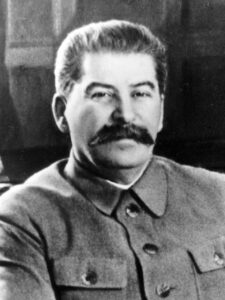
Joseph Stalin. Credit: Wikimedia Commons.
The lack of a fundamental difference between the USSR and other capitalist countries becomes even more apparent if we look at the remarks Stalin made about other “devices[s] conventionally associated with capitalism” that appeared in the USSR. Take wages, for example. Stalin told the Soviet economists that he was opposed to running “the economy on the basis of wage leveling” because “with this industry will not push forward” (p. 23). Further, he told them that “nothing will work” (p. 24) without “piecework for the workers, the bonus system for the leadership staff, and awards for peasants who work better” (p. 23). Here, Stalin is advocating for competition among wage-laborers and even saying that the Soviet government should incentivize this competition to increase the production of “surplus products” (p. 21).
For the sake of argument, let us assume that the production of “surplus products” and their distribution “according to labor” (p. 21) did lead to greater well-being among the workers in the Soviet Union. Even if this were the case—Dunayevskaya’s analysis of the Russian economy, in fact, shows a “rapid deterioration of the living standards of the masses” between 1928 and 1941—it does not mean there has been any transformation of the mode of production. In fact, the existence of “surplus products” implies the continued exploitation of workers. In Capital, Volume 1 (p. 338 of Penguin ed.), Marx writes that “we call the portion of the product that represents surplus-value … by the name of ‘surplus product.’” In other words, “surplus products” are the material form of surplus-value, which is “nothing but objectified surplus labour” (ibid., p. 325). The existence of surplus products thus entails the existence of surplus labor.
The existence of surplus labor, in turn, entails exploitation. Surplus labor refers to the labor that workers perform after they “produce the value of [their] labour-power,” and thus “gain the means of subsistence necessary for [their] own preservation or continued reproduction” (ibid., p. 324). In other words, it refers to the labor workers perform that produces surplus-value for the capitalist, value that “has all the charms of something created out of nothing” (ibid., p. 325). It is worth noting here that one Soviet economist told Stalin that “[t]he term ‘surplus product’ in socialist society is embarrassing” (p. 22). For the reasons stated above, I wholeheartedly agree.
So, it is not the case that the devices of capitalist production “transformed” themselves to serve the interests of the workers in the Soviet Union. It is the case, however, that capitalism took on a new “form of appearance.”[5] While the essence of capitalism, its relations of production, remained unchanged, the ownership of private property—that is, “the means of production in the form of capital” (Marx, Capital, vol. 3; p. 1021 of Penguin ed.) —and the distribution of commodities were, at least in part, turned over to the Soviet state. The Soviet concept of socialism then refers to a new form of capitalist production: state-capitalism.
Unfortunately, Stalinists are not the first self-proclaimed Marxists to associate socialism with changes in the mode or relations of distribution. In the Critique of the Gotha Program, Marx criticizes the “vulgar socialists” of his time and before for treating “distribution as independent of the mode of production and hence” presenting “socialism as turning principally on distribution.” He then admonishes the Eisenachers for unifying with the Lassalleans and establishing the Social Democratic Party of Germany on the basis of a program that advances this idea.[6] In other words, people who consider themselves Marxists have been making this mistake as long as there has been a Marxist movement.
Those in the Marxist movement today—be they Trotskyist, Maoist, independent, or whatever else—who use the term “socialism” to refer to an economy with substantial state planning or nationalized industry make the same mistake. As Marx repeatedly shows in his economic writings, “Any distribution whatever of the means of consumption is only a consequence of the distribution of the conditions of production themselves.” As long as the “material conditions of production,” that is, the means of production (and thus the products workers produce) are “in the hands of nonworkers in the form of property in capital and land,” and the workers are “only owners of the personal condition of production, of their labor power … then the present-day distribution of the means of consumption results automatically.”
Put another way, “if the elements of production are so distributed” in these allegedly socialist societies, then there has been no fundamental change in the class nature of these societies. Instead, the state has merely assumed the role of the individual capitalist. The point here is that a society’s relations of distribution are determined by its relations of production. And so, I ask the question that Marx posed long ago: “After the real relation has long been made clear, why retrogress again?”
C. The Consequences of Retrogression
As we have seen, for many self-proclaimed Marxists, “socialism” does not refer to a distinct mode of production associated with a classless, non-exploitative society. Instead, it refers to a shift in the relations of distribution. Insofar as these people are using the term “socialism” to refer to a post-capitalist society, they are suggesting that capitalist relations of production can exist in a post-capitalist society. In a word, they are saying that a post-capitalist society can be capitalist.
In my view, this line of argument is obviously incoherent, and thus it is obvious that it should be rejected. Yet because this paradoxical conception of socialism remains popular in the Marxist movement, I feel it is necessary to clarify its deleterious consequences. If the term “socialism,” used in the above sense, does not refer to a society with transformed relations of production, then it refers to a society where workers continue to be subjected to the specifically capitalist form of exploitation and immiseration. The concept of socialism is thus degraded. And by calling on workers to fight for this degraded concept of socialism, one is calling on workers to fight for their own exploitation and immiseration.
Essentially, the Marxian interpretation of the law of value is that only socially necessary labor time adds value to a product: “What exclusively determines the magnitude of the value of any article is … the labour-time socially necessary for its production” (Marx, Capital, vol. 1, p. 129 of Penguin ed.). Put simply, if most furniture companies can produce a table in five hours, any labor-time spent building a table in excess of five hours adds no value. However, if a furniture company can produce a table in two hours, that table will have just as much value as the tables that took five hours to produce.
Thus, “under free competition, the immanent laws of capitalist production confront the individual capitalist as a coercive force external to him” (ibid., p. 393), pushing him to constantly reduce the amount of labor-time needed to produce commodities in order to make a profit. In other words, the law of value, here, “asserts” itself as one of the “coercive laws of competition” (ibid., p. 433).
To reduce the amount of labor-time needed to produce a commodity, the capitalist must increase productivity. In Marx’s words: “In general, relative surplus-value is produced by raising the productivity of the worker, and thereby enabling him to produce more in a given time with the same expenditure of labour” (ibid., p. 534). Capitalists raise the productivity of the workers by developing a division of labor that “not only simplifies and multiplies the qualitatively different parts” of the production process “but also … regulates … the relative number of workers, or the relative size of the group of workers, for each special function” (ibid., p. 465). They also raise the productivity of the workers through “the development of the machine system” (ibid., p. 534,), that is, the introduction of new technology.
The increasing division of labor, however, only makes things worse for workers because it means busier work that is tormenting, as it requires the worker to be mind-numbingly bored. Similarly, new technology does not improve workers’ lives. For many workers, new technology means layoffs. And for those who are not laid off, it potentially means more dangerous work. Further, it means the worker is turned into “a fragment of a man” and degraded “to the level of an appendage of a machine.” In either case, life for the worker “must grow worse” because “all methods for the production of surplus-value are at the same time methods of accumulation, and every extension of accumulation, becomes a means for the development of those methods” (ibid., p. 799).
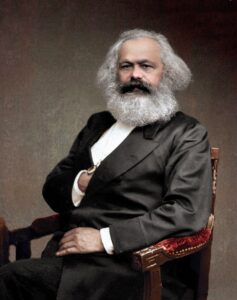
Karl Marx. Credit: Wikimedia Commons.
In summary, the law of value forces capitalists to increase productivity in the workplace. The methods used to increase productivity result in worse conditions for the worker and the further accumulation of capital in the hands of the capitalists. The further accumulation of capital in the hands of the capitalists furthers the separation of laborers from their means of subsistence, forcing them into wage-labor. And the separation of wage-laborers from the means of production assures their continued exploitation.
Here, it is important to remember that Stalin claimed that the Soviet Union could make use of the law of value in the interest of socialism. Dunayevskaya’s statistical analysis of the Russian economy suggests otherwise. In her 1942 article, “An Analysis of Russian Economy,” Dunayevskaya studies Russian industrialization from 1928-1941, “a period encompassing the First and Second Five Year Plans and that part of the Third Plan” that preceded World War II. All three plans were characterized by the Soviet attempt to increase productivity and accumulate capital “to catch up and outdistance the capitalist lands.” Despite this goal of accumulating capital, Soviet officials referred to this strategy as “socialist accumulation.” In “The Nature of the Russian Economy,” published four years later, Dunayevskaya shows that this so-called “socialist accumulation” yields the same result as capitalist accumulation: the accumulation of misery for the working class. In fact, her study of the Russian economy shows that from 1928 to 1941, “the real wages of workers” in the Soviet Union (the amounts of goods their wages could buy) “declined by half!”
This, to use Dunayevskaya’s words, “is not at all accidental.” According to Marx, “The deprivation of the worker and the abundance of capital correspond with each other, they keep in step.” As labor productivity increases and capital accumulates, “in the same proportion, the worker’s subjective poverty, neediness and dependency develop.” In this way, capitalist production is not only the reproduction of the relation between capital and labor; “it is its reproduction on an ever-growing scale.” The point here is that there is no fundamental difference for workers if it is a “socialist” state, rather than individual capitalists, that is accumulating the capital. In either case, capital accumulation leads to greater suffering for the proletariat, not “well-being of the people.”
At this point, the worst consequence of the above-mentioned retrogression becomes clear. Remember, we have already seen that much of the contemporary Marxist movement is suggesting to workers that, in a socialist society, either the bourgeoisie or the state acting as the bourgeoisie will own the means of production and therefore own the products that workers produce. Now it is clear that much of the Marxist movement is also implicitly suggesting that, in a socialist society, workers will be forced to produce the very conditions of their own exploitation and immiseration. If this is the kind of society that would exist upon realizing the prevailing concepts of socialism in the Marxist movement, it is cruel to ask, and idiotic to expect, any worker in their right mind to fight for socialism.
D. Marx’s Concept of Socialism
While nearly every Marxist tendency today claims to be Marx’s true heir, his conception of socialism could not be further from the conceptions of socialism that currently prevail in the Marxist movement. Here, I will discuss four ways Marx’s concept of socialism differs from these prevailing concepts: it turns principally on production; it is honest; it is realistic; and, if realized, it would result in a society without classes and thus without class exploitation.
Like Soviet officials, many self-proclaimed Marxists conceive of socialism as the “first phase of communism” and thus imagine a “transition from socialism to communism” (p. 24). Marx, however, did not.[7] Instead, he used the terms “socialism” and “communism” interchangeably and conceived of the “higher phase” of communism (or socialism) as developing out of the “lower phase,” which has already broken completely with the capitalist mode of production.[8] In the Critique of the Gotha Program, for example, Marx uses both terms, communism and socialism, to refer to a “co-operative society based on common ownership of the means of production.” Put another way, Marx conceived of socialist society as corresponding to a new mode and new relations of production: the socialist mode of production and socialist relations of production.
Another distinguishing feature of Marx’s conception of socialism is its honesty. The self-proclaimed Marxists who claim that capitalist relations of production can exist in a socialist society are accommodating to the indefinite existence of capitalism, and they present their accommodation as the path to a post-capitalist society. Put another way, they are presenting their abandonment of the class struggle as a commitment to a classless future and presenting the continued exploitation of workers as the self-emancipation of the proletariat. At best, this is wrong-headed and misleading. At worst, it is dishonest.
Marx, on the other hand, argued that socialist society is a classless, non-exploitative society based on the collective ownership of the means of production by freely “associated producers” who regulate their interchange with each other and nature in “a rational way” (Capital, vol. 3; p. 959 of Penguin ed.). Further, his work implies that everything will be fundamentally the same for workers until this society is established. Finally, he began to identify what economic and social conditions are needed for this society to be possible, and he ruthlessly criticized the many non-solutions that emerged in the socialist movement.
It is this brutal honesty that makes Marx’s concept of socialism realistic, in the sense of comprehending and explaining what is required to achieve the self-emancipation of the proletariat. In the Critique of the Gotha Program, Marx clearly identifies what is required to establish the socialist mode of production: common ownership of the means of production, abolition of production for the purpose of exchange, abolition of value (in the capitalist sense), and directly or immediately social labor. These transformed relations of production, he argued, are necessary for socialist society to develop “on its own foundations” to the point where
the enslaving subordination of the individual to the division of labor, and therewith also the antithesis between mental and physical labor, has vanished … labor has become not only a means of life but life’s prime want … the productive forces have also increased with the all-around development of the individual, and … all the springs of co-operative wealth flow more abundantly.
While I think all the points Marx made in this section of the Critique of the Gotha Program are fertile ground for further theorizing about how to reach a socialist society and what its characteristics are, I will restrict myself here to a few brief comments.
In this conception, there is no division of society into the proletariat or working class, “the owners of mere labour-power,” and the bourgeoisie or capitalist class, “the owners of capital” (Marx, Capital, vol. 3; p. 1025 of Penguin ed.) because the conditions and products of production are held in common by all members of society and thus there are no classes. Further, in the conception of socialism laid out in the Critique of the Gotha Program, value in the form of wages is not exchanged for value in the form of commodities. Instead, the associated producers, after making necessary deductions, distribute the products to themselves, first according to the amount of work an individual contributes to society, and, ultimately, “From each according to his ability, to each according to his needs!”[9]
Insofar as these conditions apply, the exploitation of any one individual’s or group’s labor by another individual or group is impossible. Thus, to realize Marx’s concept of socialism would be to establish a society that—given the mode, relations, and purpose of production and the resulting mode, relations, and purpose of distribution—could not be anything other than classless and non-exploitative in the above sense.
Conclusion
In my view, it is extremely important to understand that the 1943 revision of the Marxian interpretation of the law of value was not an innocent and harmless misinterpretation of Marx. Instead, it was a coordinated attack on Marx’s thought and the working class in the USSR. Similarly, I think it is important to understand that the self-proclaimed Marxists of today who argue that the law of value can operate in a socialist society, or who tacitly accept this notion by basing their concept of socialism on the mode or relations of distribution, are not making a harmless error. They are, as Raya Dunayevskaya discerned as early as 1944, implicitly advancing the idea that workers will continue to be exploited in a socialist society.
Given that this vision of socialism predominates in the Marxist movement, it is not hard to imagine why so many workers are repulsed by Marxism. For this reason, I think theorists and activists who remain committed to the self-emancipation of the proletariat should follow the lead of workers who have rejected the contemporary Marxist movement on the grounds that it is yet another obstacle to their freedom. By this, I mean refusing to keep “haggling about principles” with these defenders of capitalism and instead working to distinguish Marx’s philosophy of liberation from “Marxism” as it is commonly understood. Perhaps this is how we can make Marx’s ideas appealing to workers again.
In my view, this is extremely important for the further development of the class struggle. Workers’ understanding of how to overcome the limits that capitalist production places on them is crucial to establishing a classless, non-exploitative society. Marx’s thought provides the foundation for furthering this understanding. Thus, it is an invaluable contribution to the working class’s struggle for freedom.
I also think it is extremely important to defend Marx’s insistence that we measure what exists against a concept of socialism that corresponds to a classless, non-exploitative society. Not only is this how we retain the internal coherence of our concept of socialism, but it is also how we can ascertain the true class nature of existing societies. Finally, it is by aligning our concept of socialism with a society in which workers are actually free that we can begin constructing a new bridge between the ever-present resistance of the workers and a vision of a society “in which the full and free development of every individual forms the ruling principle” (Marx, Capital, vol. 1, p. 739 of Penguin ed.).
Notes
[1] See “Section C: The Consequences of Retrogression” for a brief explanation of the Marxian interpretation of the law of value.
[2] While I aim to show herein that the Soviet Union was a state-capitalist society, I do not think that much of what I say (perhaps anything I say) about the nature of the Soviet economy is original. For this reason, I feel it is necessary to direct the reader to Raya Dunayevskaya’s writings on state-capitalism, which have greatly influenced my thoughts on the subject.
[3] I use the phrase “self-proclaimed Marxists” to refer to people who consider themselves Marxists and who others regard as such, yet who distort Marxian thought or directly contradict it. My aim is not to exclude these people from the category of “Marxists” on the grounds that they are “fakes.” Instead, by accepting the self-identification, “Marxists,” only with some reservation, I aim to draw attention to a contradiction: that many of these people’s ideas and actions are antithetical to the philosophy of the man they themselves proclaim to follow, Karl Marx.
[4] See especially the subsection “Marx’s Concepts of Directly and Indirectly Social Labor” in the linked article: Andrew Kliman, “Marx’s Critique of the Gotha Program on the Capitalism vs. Communism,” Journal of Global Faultlines 9:2 (2023): 107-126; prepublication version in With Sober Senses.
[5] In the second subdivision, “Essence,” of his Encyclopedia of Philosophical Sciences: The Logic, Hegel demonstrates that “[t]he Essence must appear or shine forth.” This shining forth of essence is appearance. I understand Marx to be using the term “form of appearance” in a similar sense—to describe one of the appearances of the subject matter he is discussing. For example, he reveals money to be the “form of appearance” of capital (Marx, Capital, vol. 1, p. 184 of Penguin ed.).
[6] The Eisenachers—referred to as such because they founded their party, the Social Democratic Workers Party of Germany, in Eisenach, Germany—were socialists heavily influenced by Marxian socialism. The Lassalleans were members of Ferdinand Lassalle’s General German Workers Association. Marx and Engels distanced themselves from that organization because of Lassalle’s cooperation with German chancellor Otto von Bismarck, among other things.
[7] For a thorough discussion of this point, see Andrew Kliman, “The Incoherence of ‘Transitional Society’ as a Marxian Concept,” published in With Sober Senses, May 5, 2013.
[8] For a thorough discussion of the difference between capitalism and communism (or socialism) in Marx’s Critique of the Gotha Program, including the “period of revolutionary transformation between capitalism and communism” and the relationship between the lower and higher phases of communism, see Andrew Kliman, “Marx’s Critique of the Gotha Program on the Capitalism vs. Communism,” Journal of Global Faultlines 9:2 (2023): 107-126; prepublication version in With Sober Senses.
[9] Marx identifies these necessary deductions as: cover for replacement of the means of production used up, an additional portion for expansion of production, reserve or insurance funds to provide against accidents, dislocations caused by natural calamities, etc., the general costs of administration not belonging to production, that which is intended for the common satisfaction of needs, such as schools, health services, etc., and funds for those unable to work.

Be the first to comment